Healthcare Art Programs: Evidence-Based Design for Hospitals and Medical Facilities
How thoughtful art programs improve patient outcomes, staff wellbeing, and HCAHPS scores. A practical guide to printing, framing, and glazing choices for hospitals, clinics, and medical campuses.
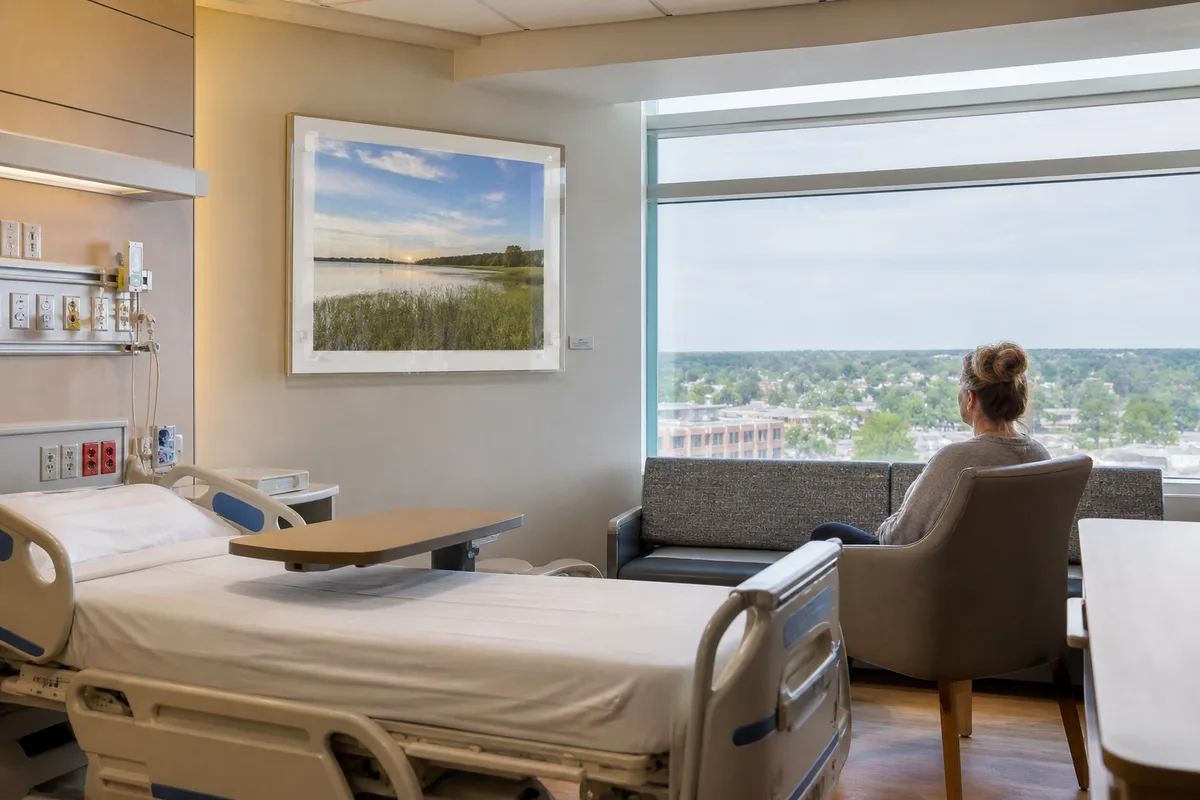
Art in healthcare is not decoration. Decades of evidence-based design research have shown that the right artwork measurably reduces patient anxiety, improves staff retention, and can influence HCAHPS patient-experience scores. But specifying art for a hospital, surgery center, or medical office building is nothing like specifying art for a hotel. The materials, the hanging methods, the content itself, and the glazing all have to pass a different set of tests.
Picture This Framing has produced art programs for hospitals, outpatient centers, dental groups, behavioral health facilities, and medical office buildings across Southern California. This guide walks through what actually matters when you're planning a healthcare art program.
Why Healthcare Art Is Different
Healthcare facilities have three constraints that hospitality and corporate spaces don't:
Patient populations in distress. Anxious, post-operative, or pediatric patients respond very differently to artwork than hotel guests. Content choice is clinical, not decorative.
Infection control protocols. Surfaces have to be wipeable with hospital-grade disinfectants without damaging the frame or artwork.
Regulatory and safety requirements. Shatter-resistance, anti-ligature hardware in behavioral health, fire ratings, and ADA clearances all shape how a piece is built and hung.
A program that ignores any one of these gets rejected by the infection prevention committee, the safety officer, or the facilities team — usually after the frames have already been produced.
Evidence-Based Content Selection
The research is clear and consistent on what works:
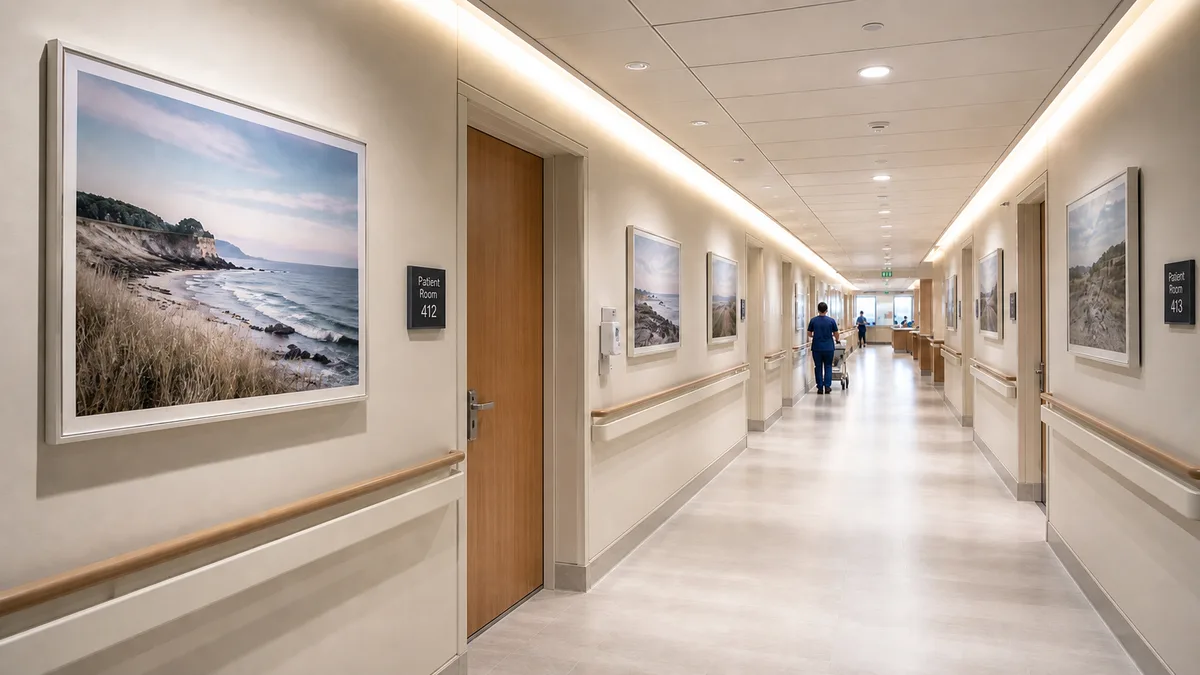
Nature imagery outperforms abstract art in reducing patient-reported anxiety and perceived pain. Landscapes with visible horizons, water, and soft light are the most consistently calming.
Abstract art can increase agitation in behavioral health and dementia-care environments. It's often prohibited in those settings.
Local and regional imagery — familiar coastlines, mountains, neighborhoods — outperforms generic stock imagery for staff morale and patient wayfinding.
Pediatric spaces need age-appropriate content without becoming visually overwhelming. Calm, curious, and whimsical beats bright and busy.
When we consult with healthcare clients, we usually recommend organizing a program around a curated content library rather than one-off selections. That way procurement, replacements, and future expansions stay consistent.
Printing for Healthcare Environments
Two printing considerations matter more in healthcare than anywhere else:
Light fastness
Hospital corridors are lit 24/7, often with high-CRI LEDs that accelerate pigment shift in lower-grade prints. We produce on archival pigment inkjet systems with papers and canvas rated for 100+ years of display permanence. For clinical areas this is a durability issue, not a collector issue — you don't want to re-print a 200-piece program in five years.
Cleanability
Prints themselves don't get cleaned, but the glazing over them does. Inkjet prints that aren't properly sealed or mounted can offgas or warp under temperature swings from HVAC. We laminate and mount to rigid substrate when a piece is going into an area where humidity or temperature is variable.
Framing and Glazing: The Infection-Control Layer
This is where most healthcare programs get built wrong. The rules of thumb:
Acrylic glazing, not glass, in nearly all patient-accessible areas. Shatter risk is unacceptable. Optical-grade acrylic with anti-reflective coating reads nearly identical to museum glass at viewing distance.
Sealed frame packages. The back should be dust-sealed so pathogens cannot harbor between the print and the backing board. A vented frame is appropriate for a museum; it is not appropriate for an oncology unit.
Smooth, non-porous frame profiles. Heavily textured or ornate mouldings harbor dust and resist disinfection. Clean-profile wood with catalyzed finish, or smooth composite, is the standard.
Anti-ligature hardware in behavioral health. Frames must be flush-mounted with tamper-resistant attachments. No wire, no protruding hooks, no removable hardware. This is a non-negotiable safety requirement.
Fire ratings where required. Class A flame-spread ratings may be required in exit corridors and some patient-care areas depending on local code and facility type.
Wayfinding, Donor Recognition, and Unit Identity
Healthcare art programs usually extend beyond decorative artwork:
Wayfinding imagery tied to floors or units ("the Coastal Floor," "the Canyon Wing") helps disoriented patients and visitors orient themselves.
Donor walls and recognition plaques are typically part of the same framing program. Consistent moulding choice across artwork and donor recognition makes the facility feel intentional rather than accumulated.
Staff-lounge and back-of-house art is often overlooked and is consistently one of the highest-impact investments for retention.
HCAHPS and the Business Case
Patient-experience scores directly affect hospital reimbursement under CMS value-based purchasing. Environmental quality is measured in the "Cleanliness and Quietness of Hospital Environment" domain, and perceived calm is influenced by visual environment. Facilities that have invested in evidence-based art programs have reported measurable lifts in environmental HCAHPS questions in the quarters following installation.
The business case for outpatient, dental, and specialty practices is simpler: patients equate a calm, considered waiting room with a competent, considered practice.
Planning and Procurement
A typical healthcare program runs 60 to 180 days from content selection to install. Key milestones:
Content workshop with clinical leadership, facilities, and design (two to four weeks).
Sample approval — physical frame and print samples reviewed under actual facility lighting.
Infection prevention signoff on frame build specification.
Production — typically four to eight weeks depending on piece count.
Staged delivery — we recommend room-by-room or floor-by-floor labeling matched to the install schedule.
Install — after-hours or phased to avoid disruption to patient care.
Frequently Asked Questions
What type of art is best for hospitals?
Nature imagery consistently performs best, especially landscapes with visible horizons, water, and soft light, which research links to lower patient anxiety and perceived pain. Abstract art can increase agitation in behavioral health and dementia care and is often avoided there.
Should hospital artwork use glass or acrylic?
Acrylic in nearly all patient-accessible areas, because shatter risk is unacceptable. Optical-grade acrylic with anti-reflective coating looks nearly identical to museum glass at normal viewing distance.
How are frames made infection-control friendly?
The frame back is dust-sealed so nothing can collect between the print and backing, and frame profiles are smooth and non-porous so they can be wiped with hospital-grade disinfectants.
What is anti-ligature hardware for artwork?
In behavioral health units, frames are flush-mounted with tamper-resistant attachments and no wire, protruding hooks, or removable hardware. It is a non-negotiable safety requirement.
How long does a healthcare art program take?
Typically 60 to 180 days: a two to four week content workshop, sample approval under actual facility lighting, infection prevention signoff, four to eight weeks of production, then staged after-hours installation.
How Picture This Framing Supports Healthcare Clients
We work with healthcare designers, facilities teams, and procurement departments across Southern California. Our healthcare capabilities include:
Acrylic glazing and shatter-resistant build specifications as standard
Sealed, dust-tight frame construction
Anti-ligature hardware for behavioral health
Archival pigment printing with healthcare-appropriate content libraries
Installer-ready packaging with room-by-room labeling
After-hours install coordination for occupied facilities
If you're planning a new medical office building, a hospital renovation, or a multi-site dental or specialty group rollout, we'd welcome the conversation. Call (714) 447-8749 or visit us at 631 S. State College Blvd, Fullerton, CA 92831.
Art in healthcare is one of the lowest-cost, highest-impact interventions available to a design and facilities team. It deserves to be specified with the same rigor as flooring, lighting, or fixtures.
Related Services
Industries We Serve
Questions About Your Project?
Our team in Fullerton is here to help with commercial art installations, custom framing, and museum-quality printing. Call us or request a quote to discuss your specific needs.