Cruise Ship Art Programs: Maritime Framing Challenges and Solutions
Discover the unique requirements for cruise ship artwork installations. Learn about weight restrictions, vibration resistance, humidity control, and international regulations for maritime art programs. Includes a materials comparison table for maritime vs. land-based framing.
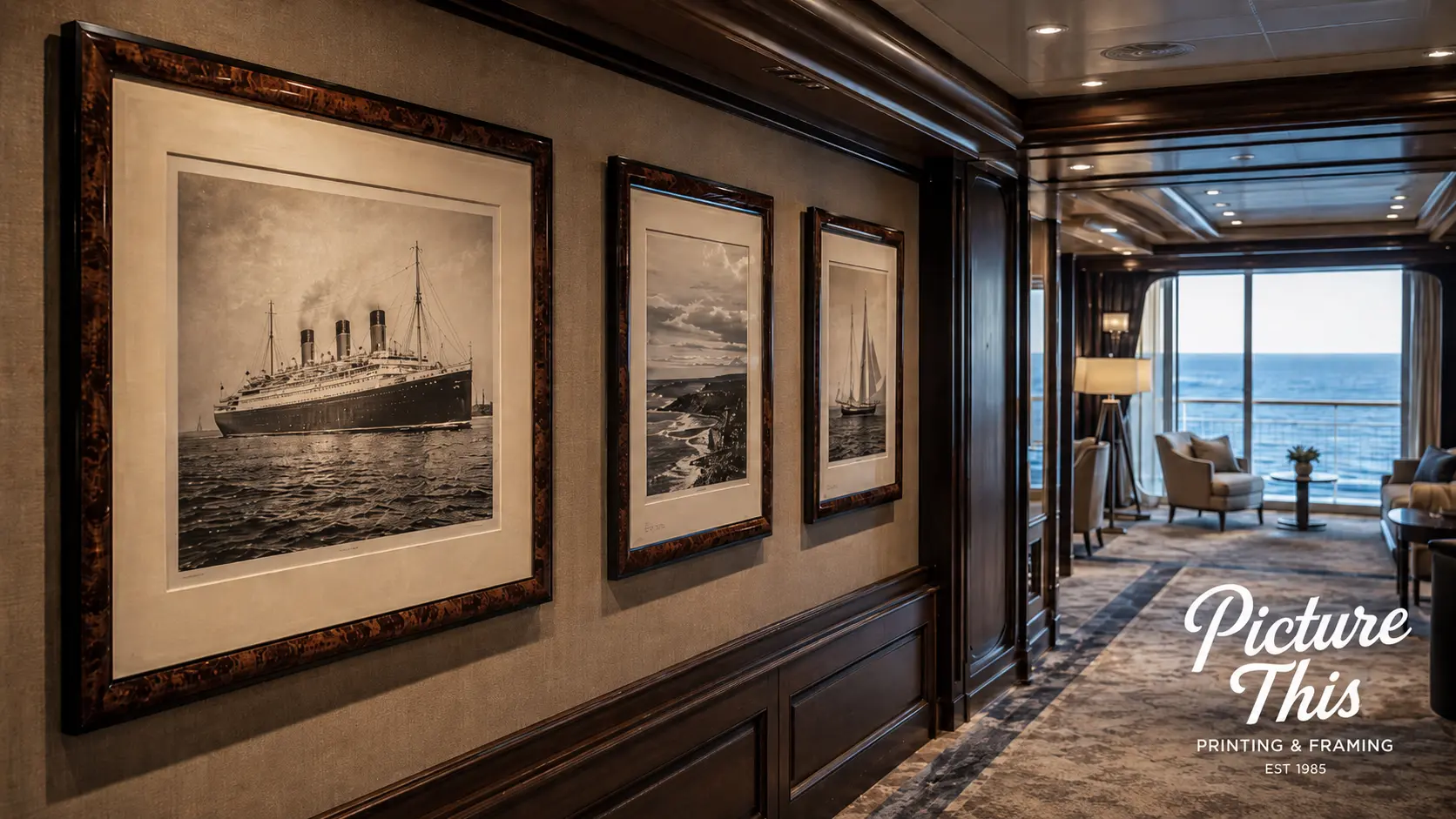
Installing artwork on cruise ships presents unique challenges that landlubbers never consider. At Picture This Framing in Fullerton, we've produced thousands of pieces for major cruise lines operating out of ports worldwide. Maritime installations demand specialized knowledge that goes far beyond traditional hospitality framing — and the consequences of getting it wrong can range from damaged artwork to failed safety inspections at port.
This guide covers everything you need to know about maritime art programs: materials selection, regulatory compliance, production at scale, installation logistics, and what separates a vendor who truly understands shipboard environments from one who's guessing.
Why Cruise Ships Need Different Solutions
Ships aren't just floating hotels — they're complex engineering environments where artwork must survive conditions that would destroy conventional framing. The challenges are layered and interconnected:
Constant vibration from engines and propulsion systems loosens hardware and fatigues frame joints over time
Continuous motion creates dynamic loads on hanging systems that land-based installations never experience
Salt air exposure corrodes metals, degrades adhesives, and attacks unsealed materials
Humidity fluctuations between outdoor decks, pool areas, and climate-controlled cabins stress wood components
Strict weight limits require lightweight alternatives to glass and heavy mouldings
Fire safety codes are significantly more demanding than any land-based building standard
Vendors who produce excellent hotel art programs often underestimate how different the maritime environment truly is. We've been asked to take over programs mid-project when a previous vendor's work began failing after the maiden voyage.
Materials Selection for Maritime Environments
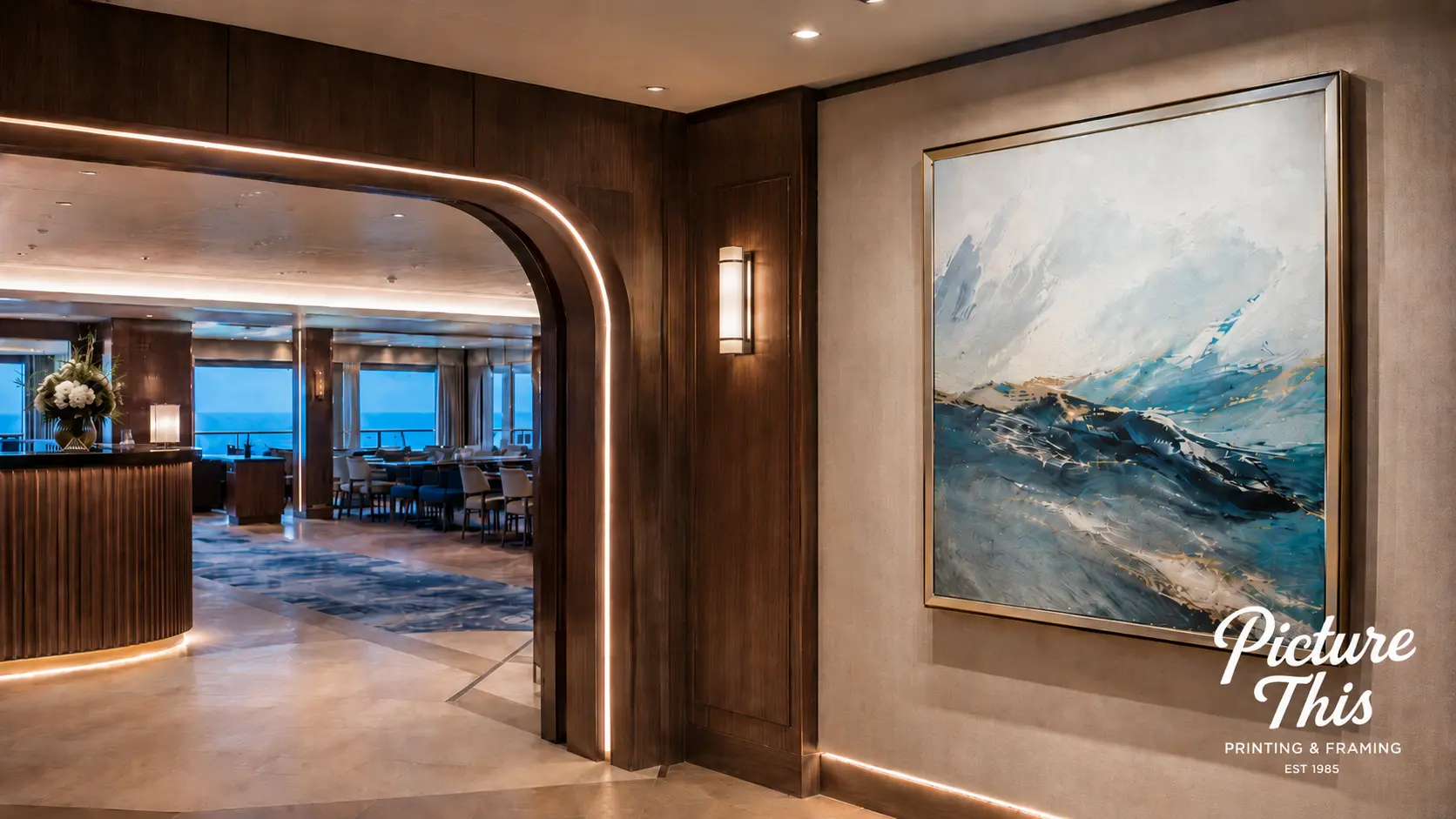
Every component in a shipboard installation must be selected with the full range of at-sea conditions in mind.
Maritime vs. Land-Based Framing: Materials Comparison
| Component | Land-Based (Hotel/Office) | Maritime (Cruise Ship) |
|---|---|---|
| Glazing | Glass or acrylic (choice) | Acrylic only — weight, safety, vibration |
| Frame material | Wood, metal, or composite | Aluminum or sealed marine-grade composite |
| Hardware | Standard steel hooks/wire | Stainless steel or marine-coated only |
| Adhesives | Standard PVA/hot melt | Marine-compatible, vibration-tested |
| Fire certification | Local building code | SOLAS + Flag State + Class Society |
| Weight budget | Rarely a constraint | Critical — affects vessel stability calculations |
| Humidity tolerance | 40–60% RH typical | 30–95% RH cycling between zones |
| Vibration resistance | None required | Continuous engine vibration + wave motion |
| Replacement logistics | Local vendor reorder | Must match original spec from production records |
This comparison illustrates why vendors experienced in hotel or corporate art programs often underestimate the engineering required for maritime installations.
Glazing: Acrylic Only
We never use glass on shipboard installations. The reasons are straightforward:
We use UV-filtering acrylic as standard on maritime projects, providing the same UV protection as museum glass while meeting shipboard weight and safety requirements.
Frame Materials: Marine-Grade Construction
Not all metals are equal in a salt air environment. Aluminum frames work well at sea — they're lightweight, corrosion-resistant, and available in a wide range of finishes. For wood frame aesthetics, we use sealed wood composite materials with marine-grade finishing that resists humidity swings without warping or delaminating.
Standard wood frames — even those that perform beautifully in hotels or offices — are not appropriate for shipboard use. The humidity cycling alone will cause joint failures and finish deterioration within a single season.
Hardware is equally critical. We use stainless steel or marine-grade coated hardware exclusively. Standard steel picture hooks will rust, leaving streaks on walls and eventually failing structurally.
Adhesives and Mounting Systems
Conventional framing adhesives can fail under the combination of humidity, vibration, and temperature fluctuation found at sea. We use marine-compatible adhesives and mechanical fastening systems that maintain integrity across the full range of maritime conditions. Every piece is tested before shipment.
Fire Safety and Regulatory Compliance
This is where maritime art programs differ most dramatically from any other commercial installation context. Cruise ships operating internationally are subject to overlapping regulatory frameworks:
SOLAS (Safety of Life at Sea)
The International Maritime Organization's SOLAS convention sets minimum fire safety standards for vessels, and its requirements filter down to interior materials including artwork and framing. Key requirements include:
Flag State Regulations
The flag state (the country where a ship is registered) may impose additional requirements beyond SOLAS. Vessels registered under certain flags have stricter requirements around tested and certified materials.
Class Society Requirements
Ships built to Lloyd's Register, Bureau Veritas, DNV, or other classification society standards may have additional interior material requirements.
What This Means in Practice
For every maritime project, we obtain and maintain material safety certifications for every component — frame materials, glazing, backing, matting, adhesives, and mounting hardware. These certifications are packaged with project documentation so the cruise line can present them during port inspections.
Vendors who produce compliant material documentation only on request are a liability. Maritime art programs require that this documentation be assembled proactively, before production begins.
Production at Scale: What It Actually Takes
Modern cruise ships are essentially small cities. A new-build large cruise vessel may require:
2,000–4,000+ framed pieces across guest cabins, corridors, public rooms, restaurants, and specialty venues
Consistent production across a build schedule that spans 12–18 months
International shipping to shipyards in Germany, France, Italy, Finland, or elsewhere
Phased delivery aligned with outfitting schedules that shift as construction progresses
In-House Production Is Non-Negotiable
For a project at this scale and complexity, single-source in-house production isn't a convenience — it's a quality control requirement. When printing, matting, framing, and finishing all happen under one roof with the same team and the same equipment, consistency across 3,000 pieces is achievable. When work is split across vendors, consistency becomes a coordination problem.
Our Fullerton facility handles the complete production workflow: artwork digitization and color management, large-format archival printing, custom matting, frame cutting and assembly, finishing, labeling, protective packaging, and crating for international shipment.
Room-by-Room Organization at Maritime Scale
A cruise ship's cabin numbering and zone designations become the organizational framework for production. Every piece we produce is labeled with its destination — deck, zone, cabin number, and wall location. Installation crews working in a shipyard cannot afford ambiguity.
For refurbishment projects where existing artwork is being replaced, we coordinate replacement sequences to minimize disruption to vessel operations.
Custom Crating for International Shipment
Artwork traveling by container to European or Asian shipyards requires crating that can survive ocean freight. We design and build custom crating solutions for maritime deliveries, including climate-controlled packaging for temperature-sensitive materials.
Installation Logistics: The Shipyard Reality
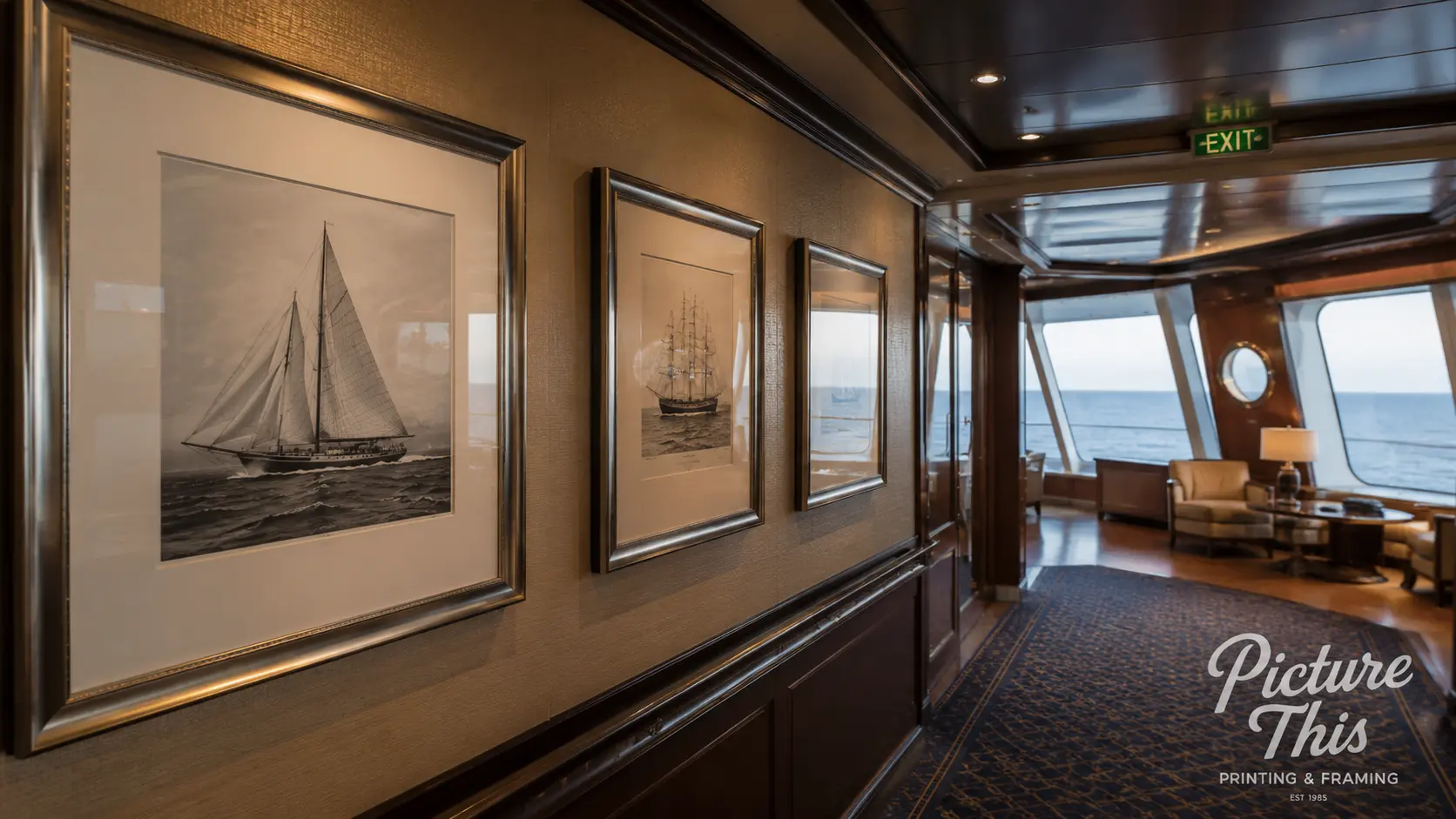
Installing artwork in an active shipyard is nothing like a hotel opening. The environment is:
Continuously active with hundreds of tradespeople working simultaneously
Dusty and physically demanding on all materials in the vicinity
Sequenced tightly — cabins become available for soft goods installation in waves as construction progresses
Subject to schedule changes driven by factors completely outside the art program
Timing and Coordination
We work with cruise line project managers and shipyard coordinators to understand the outfitting sequence for each vessel. Artwork is delivered in phases to match availability — not all at once, which would require extensive storage in an active construction environment.
For passenger spaces, installation typically follows flooring, wall coverings, and furniture — placing art installation near the end of the outfitting sequence. This protects finished pieces from construction damage.
Installation Documentation
Every installation requires detailed documentation:
Scaled floor plans showing placement dimensions for each piece
Height specifications appropriate to the viewing context (corridors, cabin headboard walls, and public spaces have different optimal heights)
Mounting instructions specifying hardware, wall substrate type, and load ratings
Photographic reference for complex arrangements
We provide installation documentation in digital and printed formats, sized for use in field conditions.
Spare Inventory
Construction sites produce damage. We produce a percentage of spare pieces above the specified quantity on every maritime project, sized to the risk profile of the installation. Having replacement pieces on site eliminates delays when something gets damaged during the final weeks of outfitting.
Refurbishment Programs: Fleet-Wide Standardization
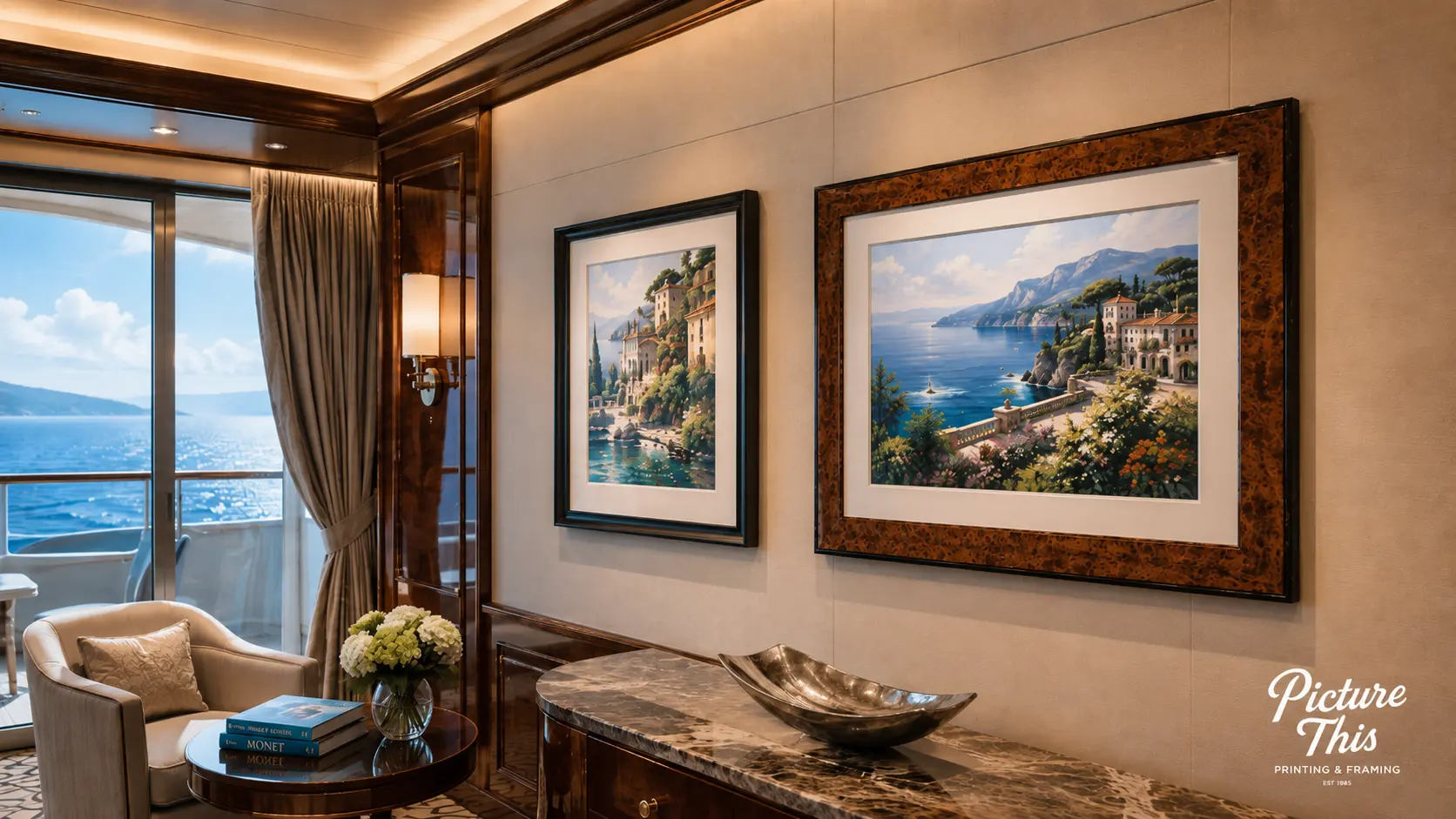
New ship construction is only one dimension of maritime art work. Cruise lines also run ongoing refurbishment programs:
Dry dock refreshes that update artwork across one or multiple vessels
Fleet-wide standardization for cruise lines seeking consistent brand identity
Damage replacement for pieces damaged during operations
Repositioning updates when a vessel changes itinerary or brand tier
Refurbishment work requires a vendor who maintains production documentation from the original installation — so replacement pieces match the originals precisely. We maintain records for every maritime project we've completed.
Frequently Asked Questions
Why is glass not used for cruise ship artwork?
Acrylic is roughly half the weight of glass, flexes instead of shattering, handles constant engine vibration better, and is often required by flag state and cruise line safety standards. UV-filtering acrylic gives the same UV protection while meeting shipboard weight and safety needs.
What frame materials work on cruise ships?
Aluminum frames and sealed marine-grade composite mouldings. Standard wood frames fail from humidity cycling, and hardware must be stainless steel or marine-coated so it does not rust.
What fire regulations apply to cruise ship art?
Shipboard art falls under SOLAS (Safety of Life at Sea), plus any additional flag state and classification society requirements. Materials need low flame spread and low smoke generation, with certifications available for inspection at any port.
How many art pieces does a cruise ship need?
A large new-build cruise ship may need 2,000 to 4,000+ framed pieces across cabins, corridors, public rooms, and restaurants, produced consistently over a 12 to 18 month build schedule.
How are replacement pieces matched during refurbishments?
By working from the original production records. We keep records for every maritime project so replacement and refurbishment pieces match the originals precisely.
Working With Picture This Framing on Your Maritime Project
Our Fullerton facility is located in Southern California, convenient to the cruise homeports at Los Angeles and Long Beach. We've produced maritime art programs for major cruise lines operating worldwide, from small river vessels to the largest ocean-going ships in operation.
What we bring to maritime projects:
40+ years of maritime-specific experience — we understand the environment because we've worked in it
Complete material compliance documentation assembled proactively, not reactively
In-house production from printing through packaging, eliminating handoff variables
Production capacity sized for the largest new-build programs
International shipping logistics for shipyard deliveries worldwide
Post-delivery support including refurbishment capability and damage replacement
Call (714) 447-8749 to discuss your maritime art project. Whether you're planning a new-build program, a fleet refurbishment, or ongoing maintenance supply, we'd welcome the opportunity to discuss your specific requirements.
Located at 631 S. State College Blvd, Fullerton, CA 92831, we're available for in-person consultations and can provide references from maritime projects of comparable scope.
Let's create artwork that weathers every voyage.
Related Services
Industries We Serve
Questions About Your Project?
Our team in Fullerton is here to help with commercial art installations, custom framing, and museum-quality printing. Call us or request a quote to discuss your specific needs.