How to Plan a Phased Art Program Across Multiple Properties: Scaling from 1 Location to 50+
A practical framework for rolling out consistent art programs across multiple hotel, healthcare, or corporate properties — phased timelines, spec control, budget modeling, and vendor coordination at scale.
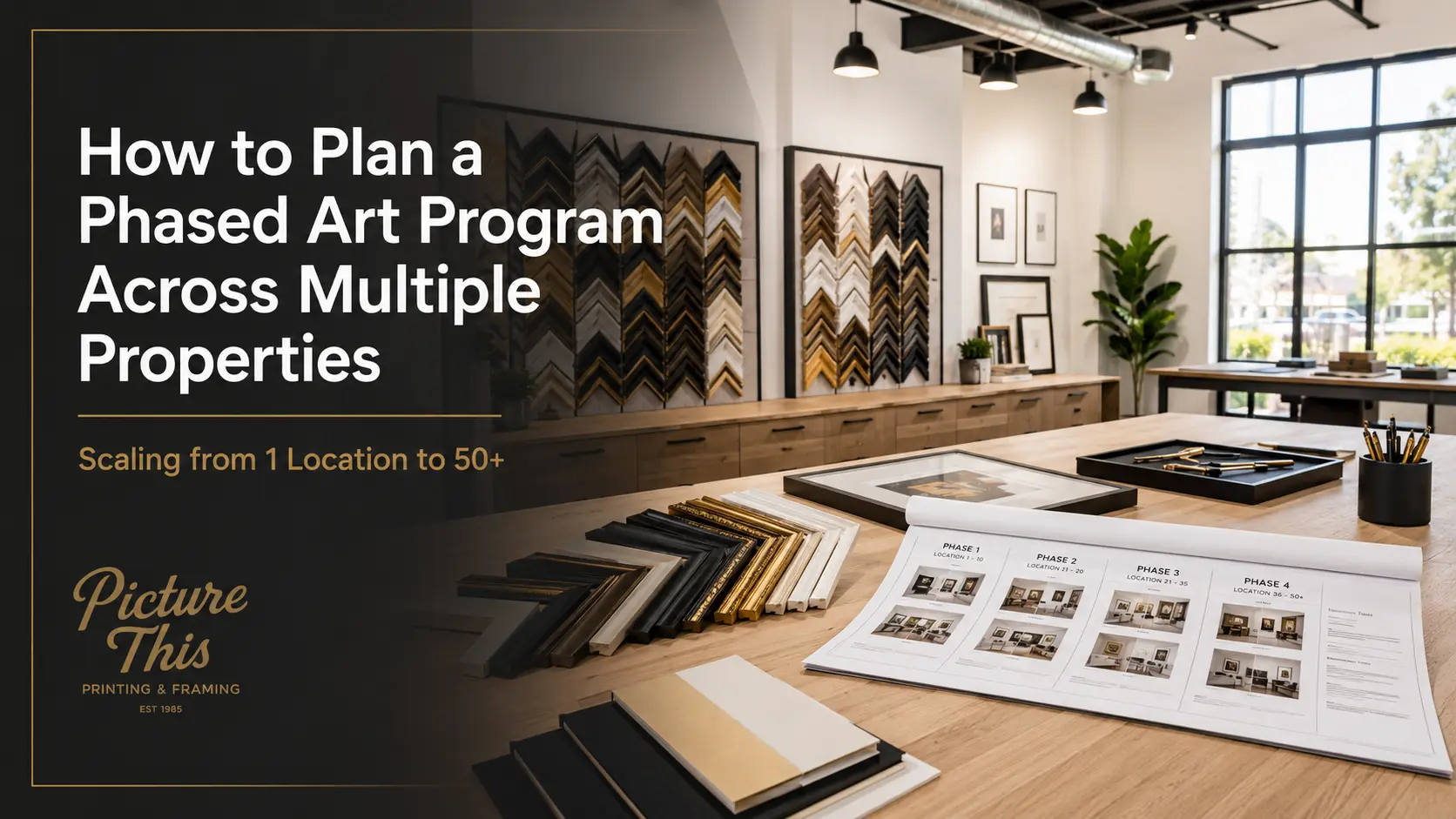
The short answer: Treat your art program like a product spec, not a project. Lock the frame, mat, glazing, and hardware standard in a master document. Phase production around your construction or renovation calendar. Order materials in bulk even if you ship in waves. The result: brand-consistent presentation across every property without re-inventing the wheel each time.
These pieces need to hang for 10 or 15 years in hotel corridors taking daily abuse — that reality shapes every material and construction decision we make. After four decades of commercial framing, we've learned where to invest in a build and where you can save without compromising longevity. We may not be the lowest number on every bid sheet, but our work holds up, and that tends to be the math that matters over the life of a program. We can work with your budget and your timeline — let's talk about what the program actually needs.
Who This Guide Is For
This is for the people coordinating art across more than one building:
Hotel brand design directors rolling out a PIP-driven art refresh across a portfolio
Senior living operators standardizing artwork for new communities coming online over 2-3 years
Healthcare system facilities teams expanding a campus or opening satellite clinics
Corporate real estate managers maintaining visual identity across regional offices
Interior designers managing multi-site hospitality or commercial projects for a single owner
If you're framing 50 pieces for one lobby, our Commercial Art Installation Cost Guide is more relevant. This guide is for programs measured in hundreds or thousands of pieces across multiple rooftops.
Why Phased Rollouts Fail (And How to Prevent It)
Most multi-property art programs don't fail on the first location. They fail on the third, or the fifth, or the twentieth — when the original designer has moved on, the vendor's stock has changed, or nobody remembers what was specified two years ago.
Common failure points:
Spec drift. Each property gets slightly different frames because nobody documented the exact moulding profile, finish code, and mat spec.
Vendor inconsistency. Different locations use different local framers. Quality, pricing, and turnaround vary wildly.
Budget surprises. Each phase gets re-quoted from scratch, costs creep upward, and the fifth property costs 30% more than the first.
Timeline collisions. Three properties open in the same quarter and the vendor can't handle the surge because nobody planned production capacity.
Content confusion. Artwork files get mixed between properties, resolutions vary, and the print quality at location #8 doesn't match location #1.
Every one of these is preventable with upfront planning. Here's the framework.
Phase 1: Build the Master Specification
Before you frame a single piece, create a master spec document that locks the following:
Frame Specification
Moulding profile: Exact manufacturer, profile number, and width. For custom milling, lock the profile drawing and finish formula.
Finish: Specific finish code, sheen level, and application method. Not "dark walnut" — the exact stain number, topcoat, and sheen.
Joining method: Glue-and-nail, v-nail only, or splined. This affects durability and repairability.
Mat & Mount Specification
Mat board: Brand, color number, ply thickness, and whether an accent or reveal liner is included.
Mounting method: Dry mount, float mount, hinge mount, or stretched. Each has different cost and presentation implications at scale.
Spacers/fillets: If used, specify exact dimensions and finish.
Glazing Specification
Type: Museum glass, UV acrylic, standard glass, or non-glare acrylic. See our UV-Protective Glazing Comparison for guidance.
Thickness: Important for weight calculations and hardware selection.
Hardware & Hanging Specification
Backing: Kraft paper, foam board, or sealed hardboard (sealed backs required for humidity-prone environments).
Hanging hardware: Wire, D-rings, cleat systems, or security hardware. Specify load rating.
Wall attachment: What anchors into what wall type. This varies by property and is the one spec that may need site-specific adaptation.
Artwork Specification
File format and resolution: Minimum DPI at print size, color profile (Adobe RGB, sRGB, CMYK).
Print media: Paper type, canvas type, or alternative substrate.
Ink system: Archival pigment, dye, or latex. Affects longevity and color accuracy.
The spec document is the single most valuable asset in a multi-property program. It's what allows property #47 to match property #1 three years later.
Phase 2: Prototype and Approve
Build physical prototypes before committing to volume production:
Produce 2-3 complete sample frames at final spec. Not digital mockups — actual framed pieces with the real moulding, real mat, real glazing, real print.
Install in-situ. Mount prototypes on the actual wall type under actual lighting conditions at a representative property. Viewing a sample frame in a vendor's showroom tells you nothing about how it reads in a hotel corridor with sconce lighting.
Stakeholder sign-off. Get written approval from the decision-maker (brand VP, owner, design director) on the physical sample. Photograph the approved sample with measurements and spec callouts.
Retain reference samples. Keep one approved prototype in storage for the duration of the rollout. This is your matching reference for every future production run.
Phase 3: Budget the Full Program (Not Just Phase 1)
Multi-property programs need full-program budgets, even if funding comes in phases:
Per-Unit Cost Model
These ranges reflect production-quality framing built to last — glue-and-nail joined corners, archival inks and papers, UV-protective glazing, and security hardware. This is not mass-produced commodity framing. You pay for quality once, and it holds up for the full lifecycle of your program without replacement, touch-ups, or callbacks.
| Component | Typical Range (Per Piece) | What You're Getting |
|---|---|---|
| Moulding + joining | $35 – $120+ | Real wood or premium metal, glue-and-nail on every corner — not v-nail-only production shortcuts |
| Mat + mount | $15 – $40 | Archival mat board, precision-cut, proper mounting method for the media |
| Glazing | $25 – $110 | UV-protective acrylic or glass standard — we don't install glazing that lets your art fade |
| Printing (if applicable) | $20 – $65 | Archival pigment inks on museum-grade substrates, color-calibrated to your file |
| Labor + finishing | $30 – $60 | Hand-assembled, inspected, cleaned, wired, backed, and labeled per room |
| Hardware + backing | $10 – $25 | Security hardware, sealed backs, hanging systems rated for the weight and wall type |
| Total per piece | $135 – $420+ | Typical hotel corridor program: $150–$225 per piece installed-ready |
Why this costs more than the quote you got from a production house: Because after 40+ years in this business, we know exactly what fails and why. We don't cut corners on joining (every corner is glued and nailed), we don't use non-archival materials that yellow or fade, and we don't ship with hardware that fails eighteen months in. We're not the cheapest bid you'll get — but we're almost certainly the last framer you'll need for any given program. The cheapest frame is the one you never have to replace, and these pieces need to hold up for years on walls that get bumped, cleaned, and stared at every single day.
We can work within your budget. If 200 pieces at the top spec doesn't fit, we'll find the right material and build quality that protects the art and holds up to your environment at a price point that works. That's a conversation, not a formula.
Volume Pricing Tiers
Commit to a total piece count across all properties — even if production is phased — to unlock better pricing:
100–299 pieces: Standard pricing
300–999 pieces: 8–12% volume discount
1,000–2,999 pieces: 12–18% volume discount
3,000+ pieces: 18–25% volume discount (program pricing)
These discounts apply to the committed total, not each individual shipment. A 2,000-piece program shipped in four waves of 500 prices at the 2,000-piece tier from day one.
Budget for Attrition
Build 3-5% overage into your order. Pieces break in transit, construction crews damage installed frames, and last-minute room count changes happen. Having spare inventory eliminates emergency re-orders at premium pricing.
Phase 4: Sequence Production Around Construction
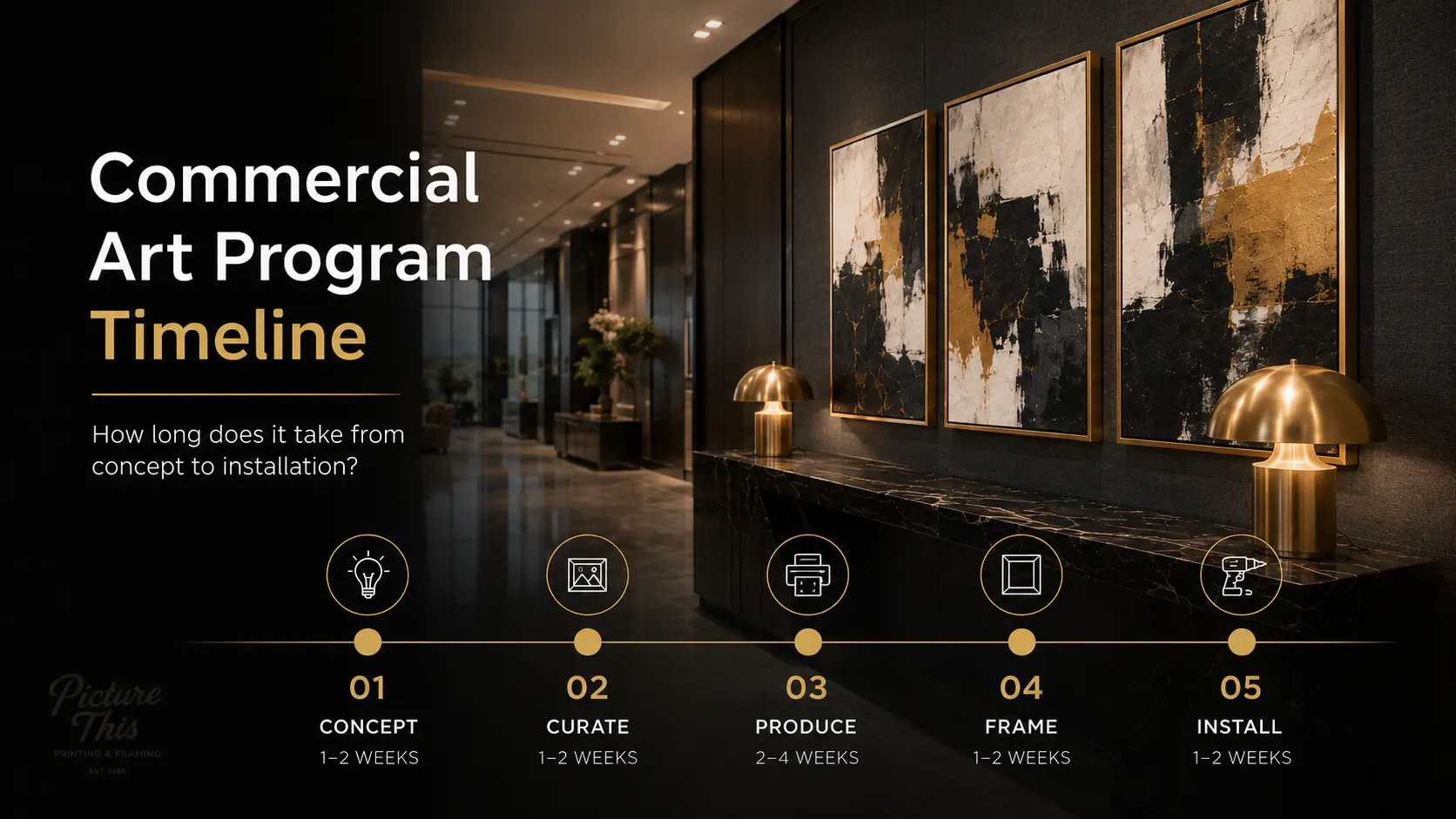
Art installation is one of the last trades in a construction or renovation sequence. Your production timeline works backward from installation date:
Timeline Framework
| Milestone | Typical Duration | Notes |
|---|---|---|
| Artwork selection | Variable (client-driven) | This is the one timeline we can't control — it depends on your approval process |
| Art proofing + color matching | 2–3 weeks | We move fast here once files are in hand |
| Material sourcing + prep | 1–2 weeks | Faster if moulding is pre-purchased for the program |
| Production | 1–4 weeks | We produce 100–200+ pieces per week depending on complexity. Identical specs run faster. |
| QC + packing | Concurrent with production | Each pallet holds 20–40 pieces depending on frame size |
| Ship to site | 5–10 business days | Multiple pallets per truck; we stage shipments around your install schedule |
| Art install | After FF&E, before photography | Coordinated with your GC or our install crew |
The bottleneck is almost never production. We can turn 200 pieces a week once specs are locked. The real timeline risk is artwork selection — getting stakeholders to approve content. Start that process first, and everything downstream compresses.
Production Capacity and Shipping Reality
Here's what governs the pace of a multi-property rollout in practice:
Production throughput: 100–200 pieces per week at our Fullerton facility. Programs with uniform specs (same frame, same size, same glazing) run at the high end. Mixed specs slow the line.
Pallet capacity: 20–40 finished pieces per pallet depending on frame size and glazing type. Larger frames = fewer per pallet.
Crating for oversize or fragile pieces: For large-format work, high-value originals, or international shipments, we custom-build wooden crates to spec. We can palletize, crate, or a combination — whatever the program requires.
Truck capacity: Each shipment carries a limited number of pallets. For a 200-room property, that's typically 5–10 pallets shipping in one or two loads.
Why we phase naturally: Only so many pieces fit on a pallet, and only so many pallets fit on a truck. Even for single-property programs, we often ship in staged loads — first shipment covers floors 1–5, second covers 6–10, timed so your install crew finishes one load before the next arrives.
We handle everything from production through packed-and-shipped. You don't need a separate logistics vendor — we palletize, crate, label by room, and coordinate delivery timing with your team at each site. After 40+ years of shipping framed art nationwide, we know how to get it there in one piece.
Staggering Multiple Properties
For a 10-property rollout opening over 18 months:
Map every property's target install date on a master calendar.
Identify production collisions — periods where more than 2 properties need art simultaneously.
Start artwork approvals early for collision periods. Production isn't the constraint — decision-making is.
Pre-purchase moulding for the full program in the first production cycle. This locks pricing and guarantees material availability regardless of when each property goes to production.
We maintain raw material inventory for active multi-property programs so your timeline isn't at the mercy of moulding supplier lead times.
Phase 5: Room-Mapping and Labeling
Every piece in a multi-property program needs to be traceable from production through installation:
Labeling System
Each frame ships with:
Property identifier (property name or code)
Floor and room number
Wall position (e.g., "above bed," "entry wall left," "bathroom")
Artwork title/file reference
Orientation (portrait or landscape)
Installation Guides
For each property, we provide:
Room-by-room placement maps showing which piece goes where
Hardware specifications for the wall type at that property
Height standards (center-of-frame height from finished floor)
Spacing standards for gallery walls or grouped installations
This system means your installation crew — whether it's our team or a local GC — can hang every piece correctly without having met the designer.
Phase 6: Quality Control at Scale
Quality that's acceptable for 20 frames becomes a liability at 2,000. Our QC process for multi-property programs:
First-article inspection. The first 5-10 frames of each production run are inspected against the master spec prototype before the full run proceeds.
In-process checks. Every 50th frame is pulled and measured against spec during production.
Final inspection. Every frame is visually inspected for finish defects, glazing cleanliness, mat alignment, and hardware before packing.
Packing + shipping prep. Corner protectors, glassine interleaving, property/room-labeled boxes, palletized or custom-crated depending on size and destination. We do it all in-house — no third-party packing vendor.
Phase 7: Ongoing Program Management
The program doesn't end at installation. Multi-property programs need:
Damage Replacement Pipeline
Attrition stock: Maintain 3-5% of total program count as replacement inventory, stored at our facility.
Re-order protocol: When a property needs replacements, they reference the master spec document. We produce and ship without re-quoting or re-specifying.
Turnaround: Replacement orders from existing spec ship in 2-3 weeks versus 6-8 weeks for new programs.
New Property Onboarding
Spec transfer: New properties receive the same master spec document. Only site-specific details (room count, wall types, artwork selections) need to be defined.
Cost predictability: New properties quote off the same volume tier, so budget planning is reliable.
Program Evolution
Artwork refresh without re-framing: Change the prints without changing the frames. Pull glazing, swap art, re-seal. Costs 60-70% less than a full replacement.
Spec updates: When a moulding profile is discontinued or a better option becomes available, update the master spec and note the version change. Previous properties retain their original spec for replacement matching.
Case Study: How Phasing Works in Practice
Scenario: A hotel management company is renovating 12 select-service properties over 30 months. Each property has 120 guest rooms plus public areas — approximately 180 framed pieces per property, 2,160 pieces total.
Approach:
Month 1-2: Master spec developed, prototypes approved. Moulding for full program pre-purchased and warehoused.
Month 3-4: First two properties enter production (360 pieces). Volume pricing locked at the 2,160-piece tier.
Month 5-30: Remaining 10 properties produced in pairs, timed to each property's renovation schedule.
Ongoing: 108-piece attrition stock maintained. Replacement orders fulfilled in 2-3 weeks.
Result: Consistent presentation across all 12 properties. Per-piece cost 18% lower than if each property had been quoted independently. Zero production delays because materials were pre-purchased.
When to Start Planning
The biggest mistake in multi-property programs is starting too late. Art feels like a finishing touch, so it gets scheduled last — then timelines compress and quality suffers.
Start the art program conversation when you:
Finalize the property list and opening/renovation schedule
Lock the interior design direction (you need design intent to select mouldings and mats)
Have at least 60-90 days before the first property needs art installed
For programs of 500+ pieces across multiple properties, we typically recommend beginning spec development 4-6 months before the first installation date. This allows time for prototype development, stakeholder approval, material sourcing, and production ramp-up without compressing any phase.
Frequently Asked Questions
How many properties can you roll out art programs to simultaneously?
It depends on piece count per property and production complexity. For standardized programs with consistent specs, we can support 3-5 concurrent property installs. For highly custom programs, we typically stage 1-2 at a time to maintain quality control.
What happens if a property opens before the art program is complete?
We plan around your construction schedule. If timelines compress, we prioritize lobby, public areas, and model rooms first — the spaces guests and stakeholders see at opening — then fulfill remaining guest rooms in a scheduled second wave.
Can we change the art package between properties?
Yes. A strong program separates the spec (frame profile, mat, glazing, hardware) from the content (the artwork itself). You can vary images between properties while keeping frames and presentation consistent, or vice versa.
How do you maintain consistency across a multi-year rollout?
We lock your spec package — moulding profile, finish formula, mat board, glazing type, hardware — in a master document. All production references this spec regardless of when the order ships. We also retain physical samples and finish chips for re-matching.
What is the minimum order to qualify for volume pricing on a multi-property program?
Programs of 200+ total pieces across all properties typically qualify for volume pricing. The larger the committed total, the better the per-unit cost — even if production is phased over months or years.
Do you handle shipping to multiple locations nationwide?
Yes. We palletize, custom-crate when needed, and ship nationwide from our Fullerton, CA facility. Each property receives its own labeled, room-mapped shipment. We coordinate delivery timing with your GC or installation crew at each site. After 40+ years of shipping framed art across the country, we know how to get it there without damage.
Start Your Multi-Property Program
We've managed phased art programs for over four decades — from 3-property renovations to 50+ location brand rollouts. We know what works, what fails, and how to build a program that holds up for years without surprises. We're not the lowest bid, but we are the last call you'll make on a program because we get it right the first time.
We can work with your budget and your timeline. Let's figure out the right spec, the right materials, and the right phasing for your specific situation.
Call (714) 447-8749 or request a consultation to discuss your multi-property program. We'll walk you through our process, send physical samples, and provide a budget model based on your property count, room count, and design direction — no obligation, no pressure. Just 40+ years of experience applied to your project.
Related Services
Industries We Serve
Questions About Your Project?
Our team in Fullerton is here to help with commercial art installations, custom framing, and museum-quality printing. Call us or request a quote to discuss your specific needs.