All Industries

Cruise Ships

Cruise Ship Art Programs: Maritime-Grade Printing, Framing & Installation for Cruise Lines

Art programs engineered for the maritime environment — no glass, weight-conscious, salt-air-resistant, and delivered crated to port on your drydock schedule.

Cruise ship art programs operate under constraints that land-based projects never encounter. Glass is prohibited on most vessels. Weight limits affect every material choice. Salt air corrodes metal hardware. International maritime schedules dictate delivery windows measured in days, not weeks. And the art itself must survive years of continuous vibration, humidity fluctuation, and passenger traffic that never stops.

Picture This Framing has produced art programs for major cruise lines, building thousands of pieces engineered specifically for the maritime environment. From our Fullerton, California facility, we produce complete programs using acrylic glazing, corrosion-resistant hardware, lightweight framing systems, and sealed construction that holds up to shipboard conditions. Everything is crated for port delivery and timed to your drydock or newbuild schedule.

What We Deliver

End-to-End Production for Cruise Ships

No-glass construction using clear, non-glare, and UV-protective acrylic glazing
Lightweight framing systems that meet vessel weight budgets
Corrosion-resistant hardware and mounting systems rated for maritime environments
Sealed dust covers that protect against humidity and salt-air exposure
Port-ready crating and international freight coordination
Cabin-by-cabin and deck-by-deck labeling for drydock installation efficiency
Production volumes from 500 to 5,000+ pieces per vessel
Drydock schedule synchronization — production timed to your shipyard window

Our Production

Built In-House, Built to Last

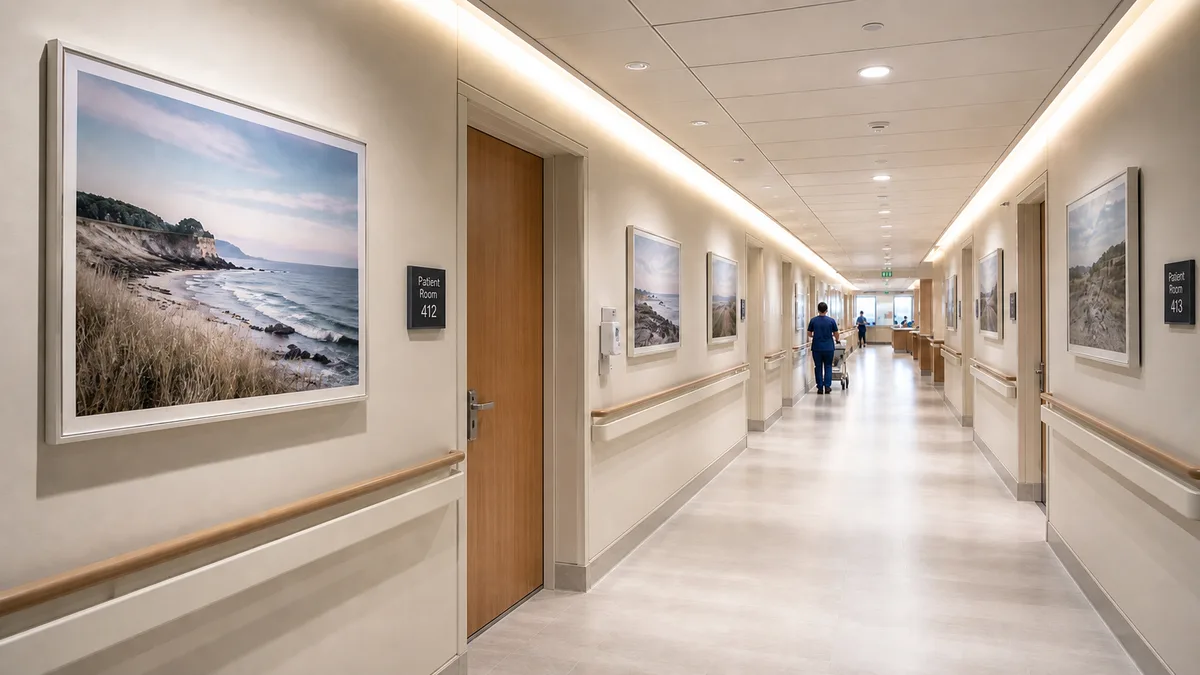
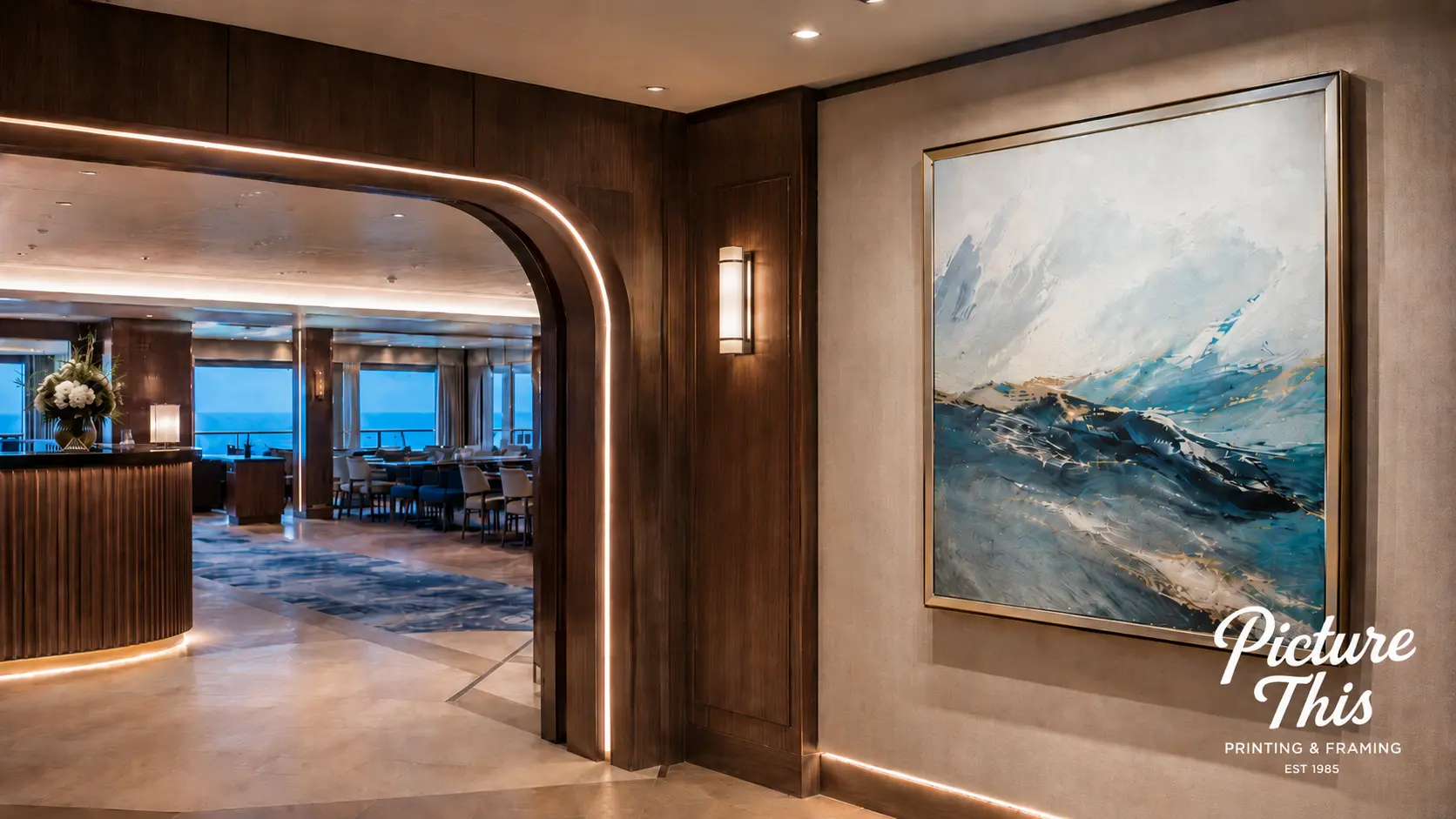
Custom framed artwork installed in cruise ship corridor
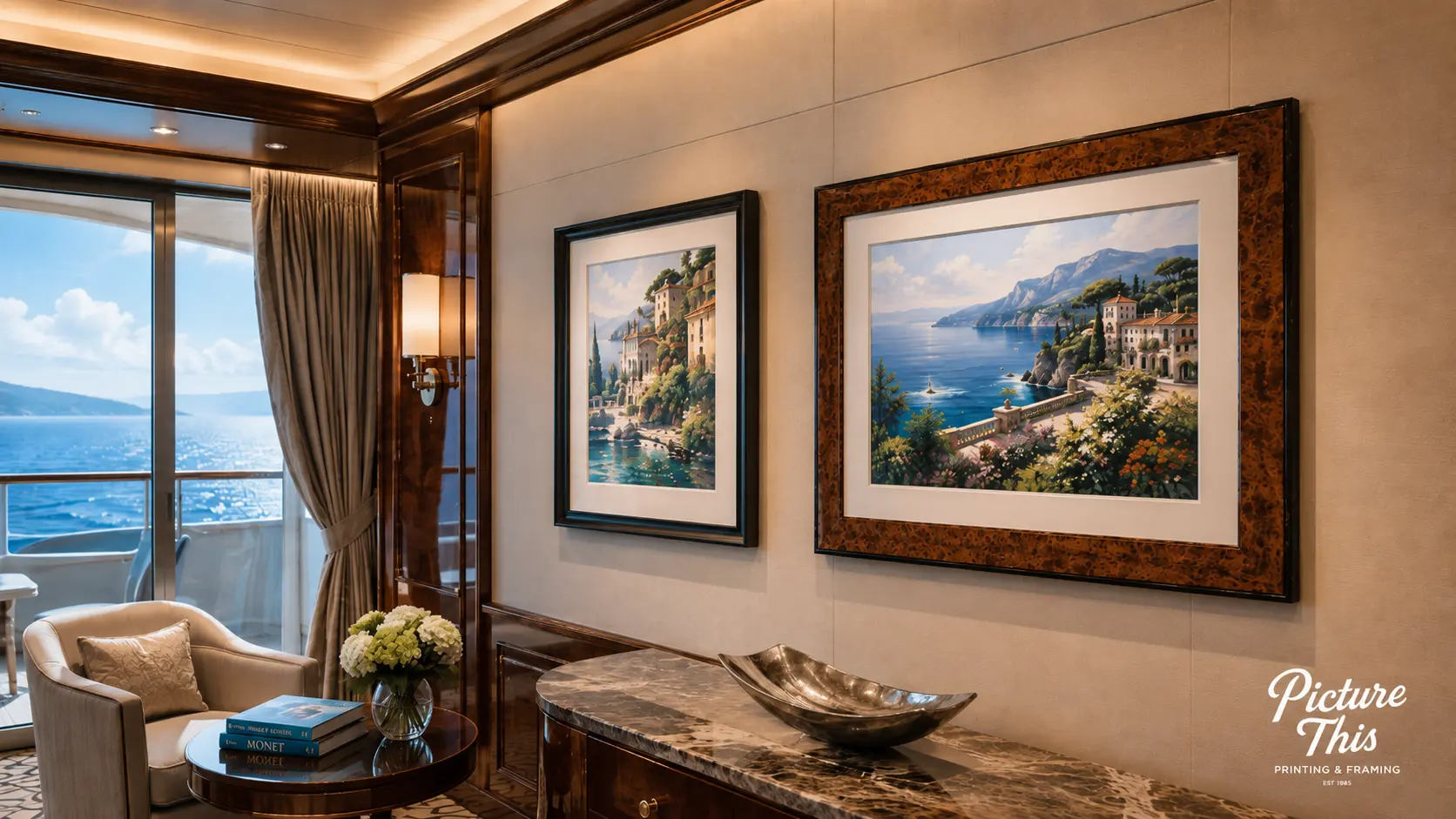
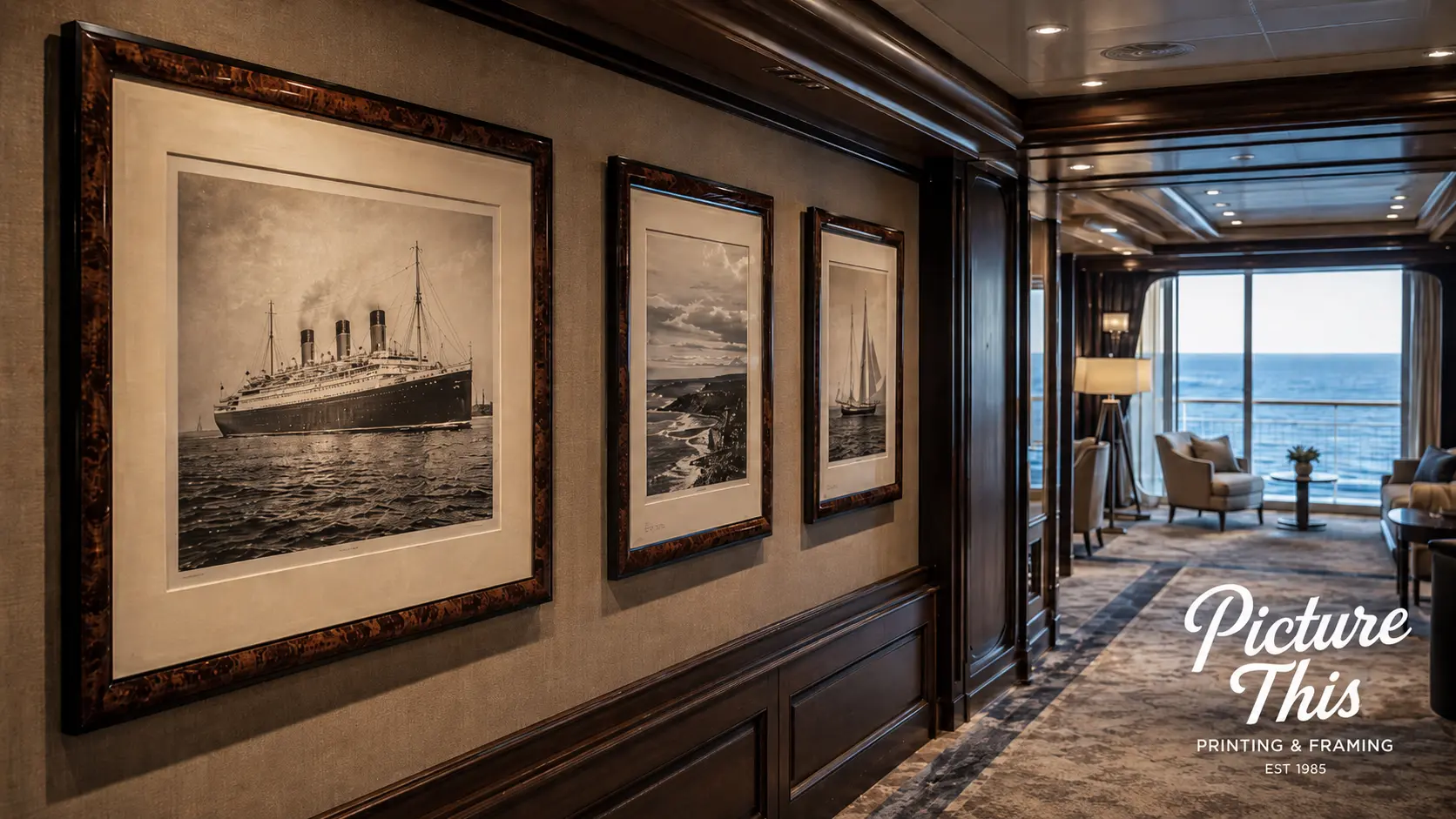
Premium framed artwork in luxury cruise ship suite
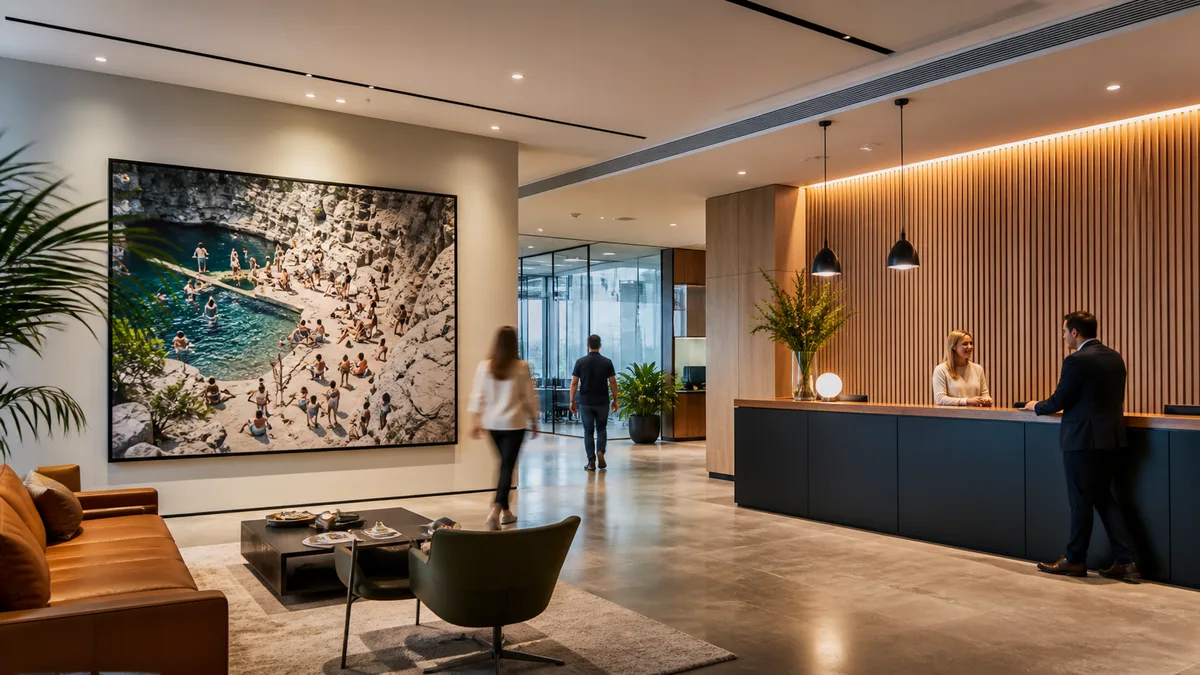
Art installation in modern cruise ship public space
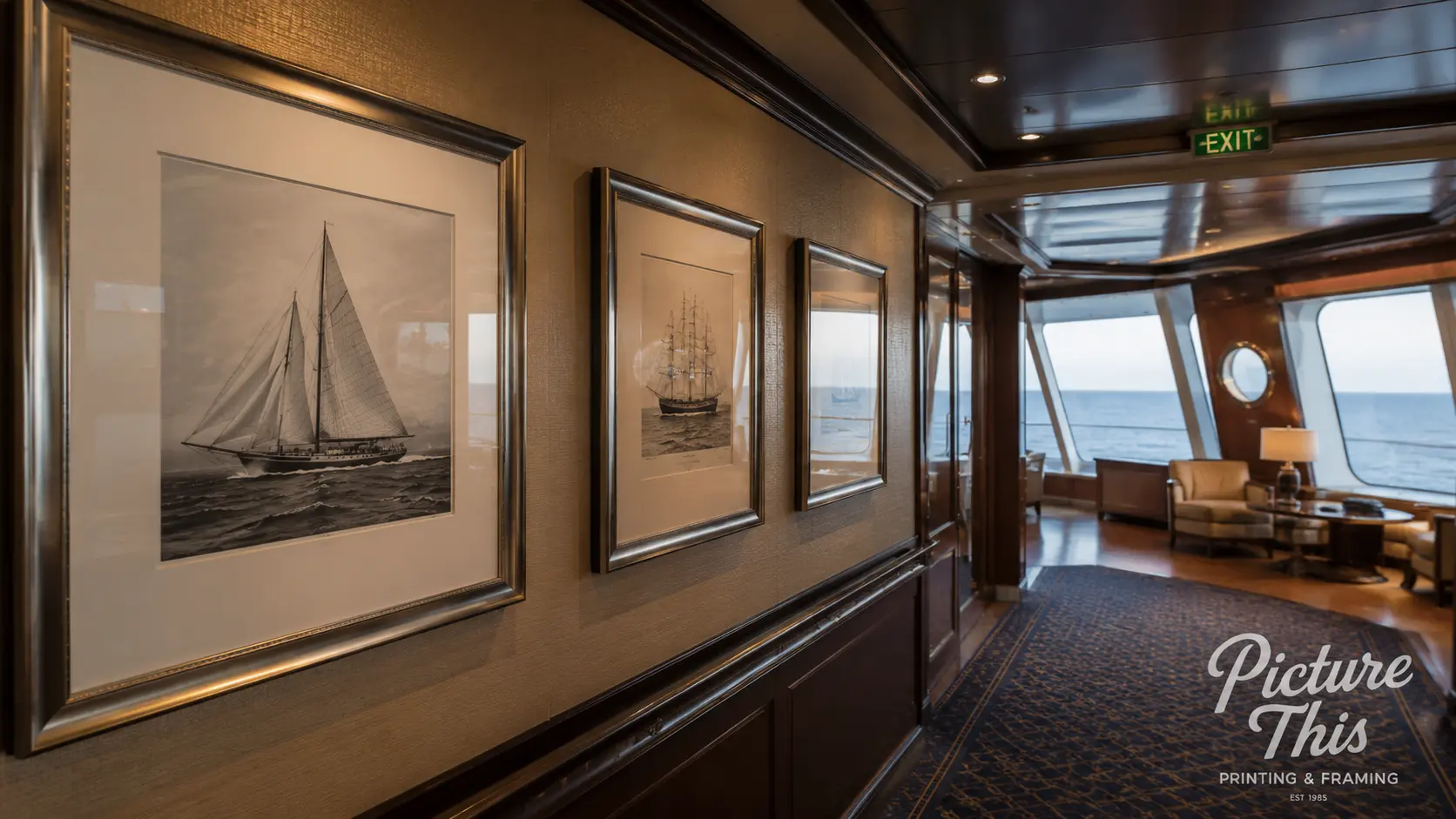
Nautical art installation in cruise ship corridor with maritime-grade framing

The Difference

Maritime-Experienced Producer vs. Land-Based Frame Shop

Glazing
Picture This

Acrylic-only construction — zero glass on the vessel

The Alternative

Glass frames that violate maritime safety regulations

Weight
Picture This

Lightweight profiles engineered to meet naval architect weight budgets

The Alternative

Standard hardwood frames that exceed cabin weight allocations

Hardware
Picture This

Corrosion-resistant stainless or coated fasteners rated for salt air

The Alternative

Standard steel hardware that corrodes within months at sea

Moisture Protection
Picture This

Sealed dust covers and vibration-absorbing bumpers as standard

The Alternative

Open-back frames that trap moisture and rattle against walls

Production Scale
Picture This

3,000-5,000+ pieces from one facility on drydock deadlines

The Alternative

Cannot produce at volume; misses drydock window by weeks

Delivery
Picture This

Port-ready crating sized for crane loading and shipboard distribution

The Alternative

Cardboard packaging that does not survive port logistics

Labeling
Picture This

Deck-by-deck, cabin-by-cabin labeling for rapid drydock install

The Alternative

Unlabeled pieces require days of sorting during a tight drydock window

01

Why Glass Cannot Go on a Cruise Ship

Maritime safety regulations prohibit glass in most areas of a passenger vessel. A glass-glazed frame that falls off a wall during rough seas becomes a lethal hazard. Even in calm conditions, the constant vibration of a moving vessel loosens glass over time, creating a failure mode that does not exist on land. We use acrylic glazing exclusively for cruise programs — clear acrylic for standard installations, non-glare acrylic for corridors with direct lighting, and UV OP3 acrylic for areas with significant sunlight exposure through windows and atriums.

02

Weight Budgets and Material Selection

Every pound matters on a vessel. Naval architects assign weight budgets to every cabin, deck, and public space, and the art program must fit within those allocations. We spec lightweight moulding profiles, thin acrylic glazing, and aluminum or composite framing systems that deliver a premium look without the weight penalty of traditional hardwood frames with glass. For a 3,000-piece program, the difference between standard and optimized framing can be thousands of pounds — a significant consideration for vessel stability and fuel efficiency.

03

Surviving the Maritime Environment

Salt air corrodes unprotected metal within months. Humidity fluctuations cause paper to buckle and adhesives to fail. Constant engine vibration works screws loose and rattles frames against walls. We address each of these with material choices that most frame shops never consider: stainless steel or coated hardware, moisture-sealed dust covers, vibration-absorbing bumpers, and archival mounting techniques that accommodate humidity-driven expansion and contraction.

04

Drydock Scheduling and Port Delivery

A cruise ship drydock window is measured in days. If the art program is not ready when the ship enters the yard, it does not get installed — and the next window might be a year away. We synchronize our production schedule with your drydock dates, building backward from the delivery-to-port deadline. Crating is designed for crane loading and shipboard distribution. Every piece is labeled by deck and cabin so the install crew can work efficiently through the vessel without delays.

05

Fleet-Wide Art Programs Across Multiple Vessels

Cruise lines rarely operate a single ship. A fleet-wide art program requires consistent quality, color, and framing specifications across every vessel while accommodating the different layouts, cabin configurations, and public-space designs of each class. We centralize production so every ship in the fleet receives art built to the same standard — same moulding profiles, same substrates, same finishing — while adjusting piece counts and sizes to each vessel's deck plans. Fleet programs are phased to match individual drydock schedules, so each ship gets its art when its yard window opens, not all at once.

06

What a Typical Cruise Ship Art Program Looks Like

A mid-size cruise program — roughly 2,500 to 3,500 pieces for a single vessel — typically includes cabin art (the largest piece count, usually 60–70% of the program), corridor and stairwell pieces, public-space feature art for the atrium, dining rooms, and entertainment venues, plus suite-level premium pieces with upgraded framing. Cabins usually receive two to three pieces each in a coordinated palette. Public spaces receive larger-format work with heavier framing for visual impact. The entire program is produced under one roof, crated by deck, and shipped to port in a single coordinated delivery.

07

IMO and SOLAS Compliance Considerations

International Maritime Organization (IMO) and SOLAS regulations govern materials aboard passenger vessels. Art materials must meet flame-spread and smoke-generation requirements. We work with your maritime compliance team to ensure substrates, adhesives, and framing components meet the applicable standards for each installation zone on the vessel. Documentation is provided for every material used so your compliance officer can verify conformance before the art goes on board.

Need a quote for your cruise ships project?

Tell us about your program — piece count, timeline, and any special requirements. We respond within one business day.

Start Your Project

9 Non-Negotiable Requirements for Cruise Ship Art Programs

1

Zero glass on the entire vessel

Acrylic glazing is mandatory for maritime safety. Every piece must use clear, non-glare, or UV-protective acrylic — no exceptions.

2

Weight-compliant framing for every cabin and public space

Framing must fit within naval architect weight budgets. Lightweight moulding profiles and thin acrylic keep weight within allocation.

3

Corrosion-resistant hardware throughout

Standard steel hardware corrodes in salt air within months. Stainless steel or coated fasteners are required for maritime longevity.

4

Sealed construction against humidity and salt air

Moisture-sealed dust covers and archival mounting prevent buckling, mold, and adhesive failure in the marine environment.

5

Vibration-resistant mounting systems

Engine vibration loosens standard hanging hardware over time. Maritime-rated mounting systems and vibration-absorbing bumpers prevent frame drift and wall damage.

6

Deck-by-deck and cabin-by-cabin labeling

Drydock install windows are too short for sorting. Every piece must be labeled and crated by deck for rapid distribution.

7

Port-ready crating for crane loading

Artwork must arrive at port in crates sized for shipboard handling. Standard cardboard packaging does not survive port logistics.

8

Production capacity for 3,000 to 5,000+ pieces

Cruise programs are large. Your vendor needs the production capacity to deliver thousands of pieces on a fixed drydock deadline.

9

Drydock-synchronized delivery timing

If the art misses the drydock window, the next opportunity may be a year away. Production must be timed precisely to your shipyard schedule.

Our Process

How Your Cruise Ships Program Gets Built

1

Program Specification & Weight Review

We review your deck plans, piece counts, weight budgets, and drydock schedule. Material specifications are tailored to maritime requirements — no glass, corrosion-resistant hardware, lightweight profiles.

2

Proofing & Material Approval

Physical proofs on the actual substrates and framing specified for the vessel. You see exactly what will go on the ship before we commit to full production.

3

Production at Scale

Our Fullerton facility handles production volumes up to 5,000+ pieces. Every piece is built to maritime specification, inspected, labeled by deck and cabin, and crated for port delivery.

4

Port Delivery & Drydock Installation

Crates arrive at port on your schedule, sized for crane loading and shipboard distribution. Install crews receive deck-by-deck documentation for maximum efficiency during the drydock window.

Our best work is under wraps.

Our clients like it that way.

What we can tell you: you've almost certainly seen it. In person. Probably more than once.

Call us and ask — we love that conversation.

Let's Talk

Where We Work

Produced in our Fullerton, California facility with port delivery to any U.S. or international shipyard
Crated and shipped to cruise ship ports in Miami, Fort Lauderdale, Cape Canaveral, Galveston, and international destinations
Over 40 years of commercial art production including large-scale maritime programs
Capacity for 3,000 to 5,000+ piece programs from a single production facility

Frequently Asked Questions: Cruise Ships

Yes. We have produced programs of this scale from our Fullerton facility. Our in-house production capacity — printing, framing, finishing, and crating — is built for high-volume programs with fixed deadlines. A 3,500-piece cruise program we delivered took approximately 9 months from kickoff to final crate on the ship.

We use three types depending on location: clear acrylic for standard cabin installations, non-glare acrylic for corridors and areas with direct lighting, and UV OP3 acrylic for public spaces with significant sunlight exposure through windows and atriums. All are shatter-resistant and lightweight.
We crate artwork in port-ready containers sized for crane loading and shipboard logistics. Freight is coordinated to arrive at the specified port within your drydock window. We have shipped to ports in the United States, Europe, and Asia for cruise line clients.

Lightweight composite and aluminum profiles are ideal for maritime applications. They deliver a premium look without the weight penalty of solid hardwood, and they resist the humidity and temperature fluctuations of the marine environment better than natural wood.

We use vibration-absorbing bumpers on the back of every frame, security mounting hardware that resists loosening, and sealed dust covers that prevent internal component movement. These details are standard for every maritime piece we produce — they are not upgrades or add-ons.

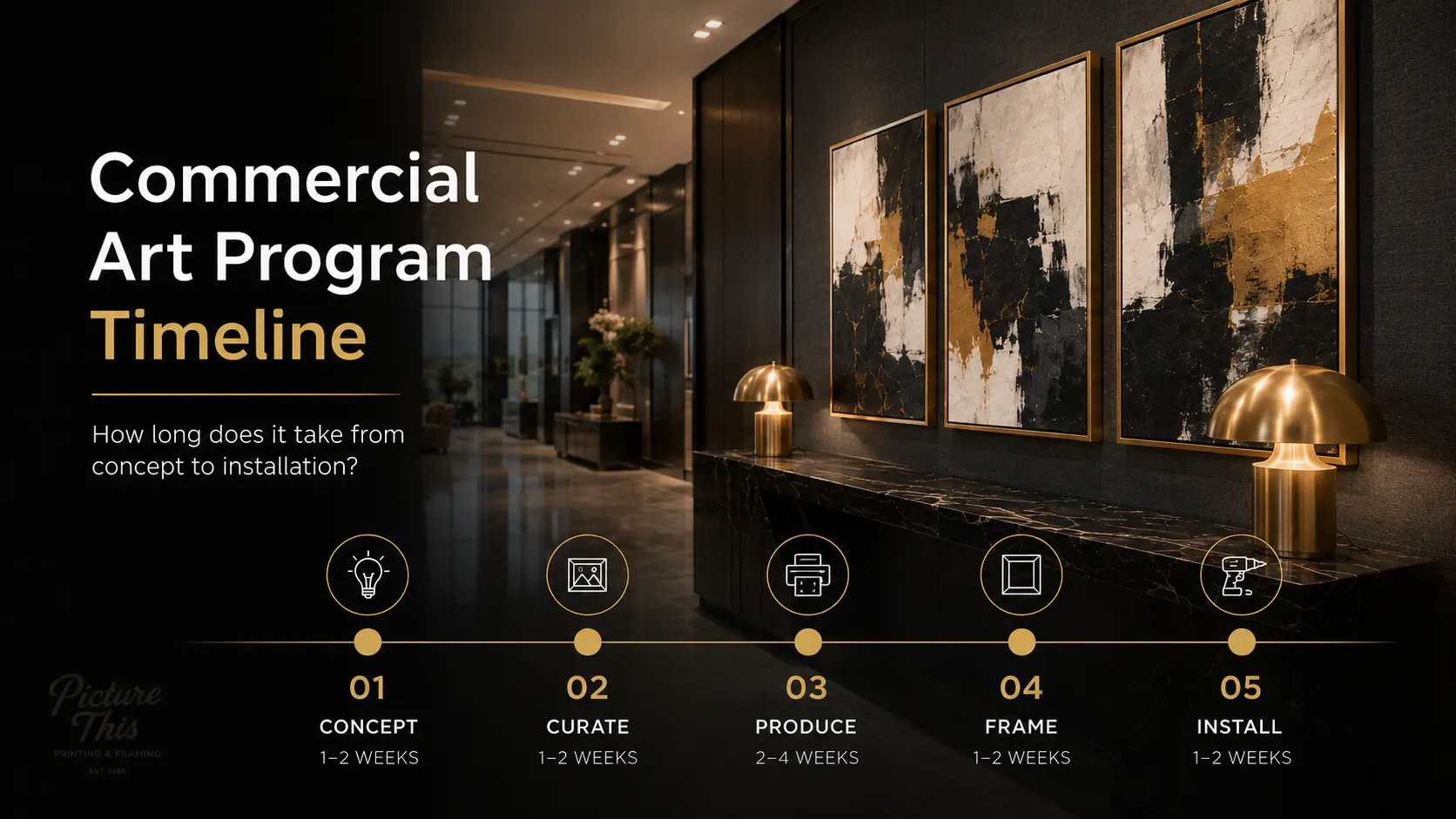
A full cruise ship program typically runs 8 to 12 months from kickoff to port delivery. The timeline is driven by moulding procurement at scale, production volume, and your drydock schedule. We build the production plan backward from your drydock date to ensure on-time port delivery.

Budget varies by vessel count, piece count per ship, framing tier, and delivery logistics. A single-vessel program of 2,500 to 3,500 pieces typically falls in the mid-six-figure range. Fleet programs spanning multiple vessels benefit from volume pricing on moulding and substrates. We provide detailed per-piece line-item quotes after reviewing your deck plans and specifications so procurement can compare apples-to-apples across vendors.

We work with your maritime compliance team to ensure substrates, adhesives, and framing components meet applicable flame-spread and smoke-generation standards for each installation zone. Documentation is provided for every material used so your compliance officer can verify conformance before installation.

Yes. Fleet programs are structured so each vessel receives its art when its drydock window opens. We lock the master specification once and then produce each ship's allocation on its own timeline, using the same moulding, substrates, and finishing so quality is identical across every vessel in the fleet.

Each cabin class — interior, balcony, suite, and premium suite — typically receives a different art specification. Suites get upgraded framing, larger formats, and sometimes premium substrates. We spec each tier separately, produce them in a single production run, and label every piece by deck, cabin number, and class so the install crew places the right art in the right room without guesswork.

Planning a Cruise Ship Art Program?

Share your vessel details, piece count, and drydock schedule. We will build a production plan engineered for the maritime environment and timed to your shipyard window.