Art Spec Packages: What to Include in Your RFP So Vendors Can Actually Quote It
The information commercial framing vendors need to give you a real number — and why budget alignment, material availability, and timeline are the hidden factors that shape every quote.
The short answer: Give us piece count, sizes, frame and mat preferences, whether we are printing or you are supplying files, your budget range, and your install date. That is what it takes to get a real number back instead of a padded guess. But the pieces most people miss — budget alignment, material availability at volume, and timeline — are what actually determine whether a project lands on spec, on budget, and on time.
We have quoted thousands of commercial art programs over 40 years. The difference between a smooth project and a painful one almost always traces back to the information exchange at the beginning. This guide is for the designers, procurement managers, and project coordinators who write RFPs and spec packages — here is what makes a vendor's job easy, and what gets you a better quote.
The Obvious Stuff (That Still Gets Left Out)
Every vendor needs the same baseline information. If your RFP includes these clearly, you will get faster, more accurate quotes from everyone on your bid list:
1. Piece Count
Total number of framed pieces. If you have different tiers (lobby vs. corridor vs. guestroom), break them out separately. A 200-piece program with 180 guestroom pieces and 20 statement lobby pieces is a fundamentally different production plan than 200 identical corridor frames.
2. Sizes
Exact dimensions if you have them. If you are still in design, provide a range or reference ("most pieces 24x36, with six to eight large-scale pieces in the 40x60 range"). This matters for material yield, press scheduling, and packaging.
3. Frame and Moulding Direction
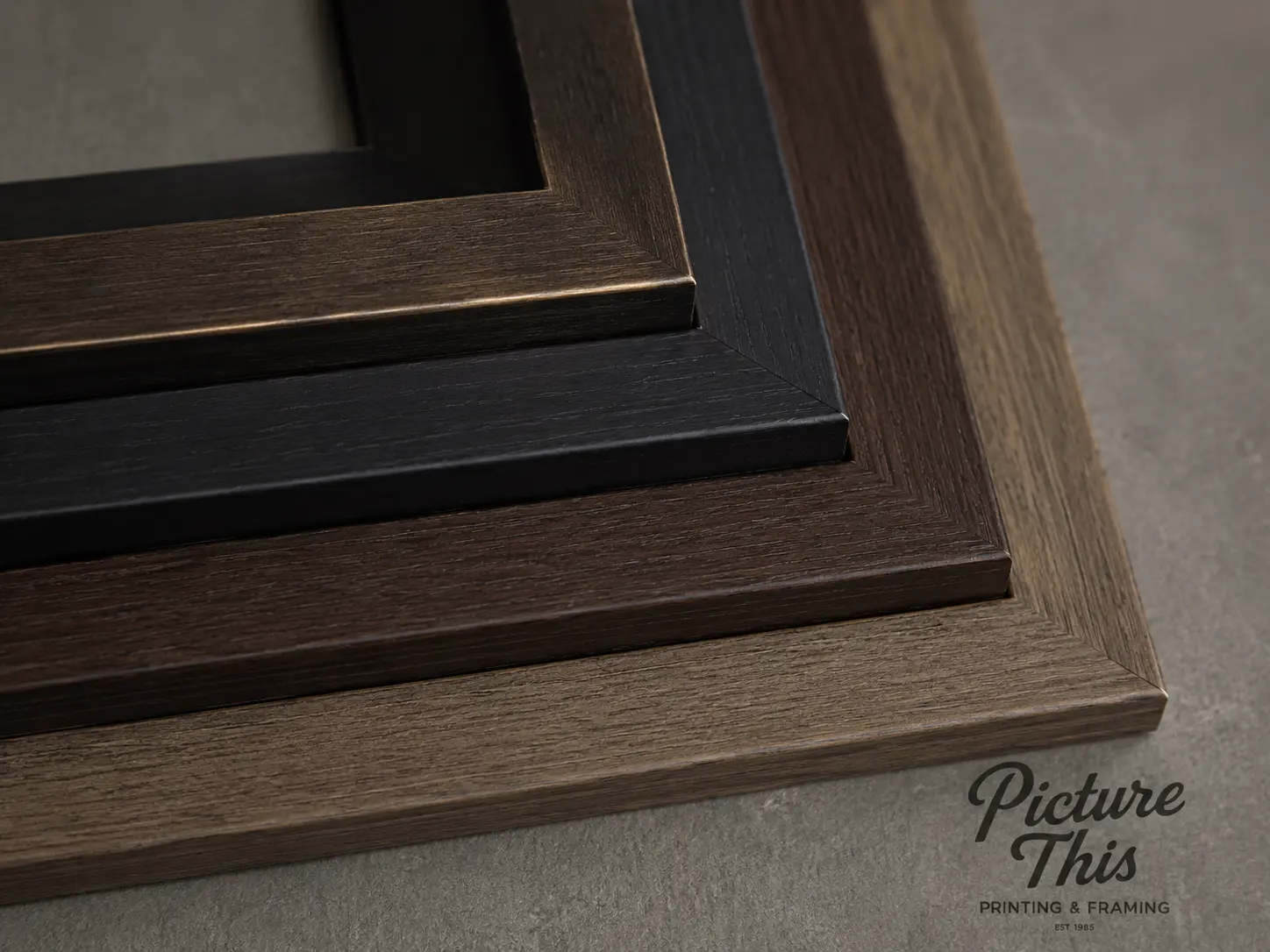
You do not need to specify a SKU — in fact, specifying a *look* rather than a specific product gives your vendor more room to find the best value. "Warm walnut tone, clean modern profile, 1.5-inch face" tells us everything we need. If you have a sample or reference image, even better. (Not sure where to start? Our Wood vs. Metal vs. Composite Moulding Guide breaks down when each material type makes sense for commercial programs.)
4. Matting
Single mat, double mat, float mount, no mat. If you want a specific mat board color or ply, note it. If you are open to our recommendation, say so — that flexibility often saves money.
5. Glazing
Acrylic or glass? UV protection needed? Anti-reflective? Shatter-resistant required (healthcare, hospitality corridors, maritime)? If you are unsure, tell us the environment and we will recommend. (For a deep dive on glazing options and when each makes sense, see our UV Protective Glazing Comparison Guide.)
6. Print or Client-Supplied Art
This is a major cost and timeline variable. If we are printing, we need to know:
File format and resolution
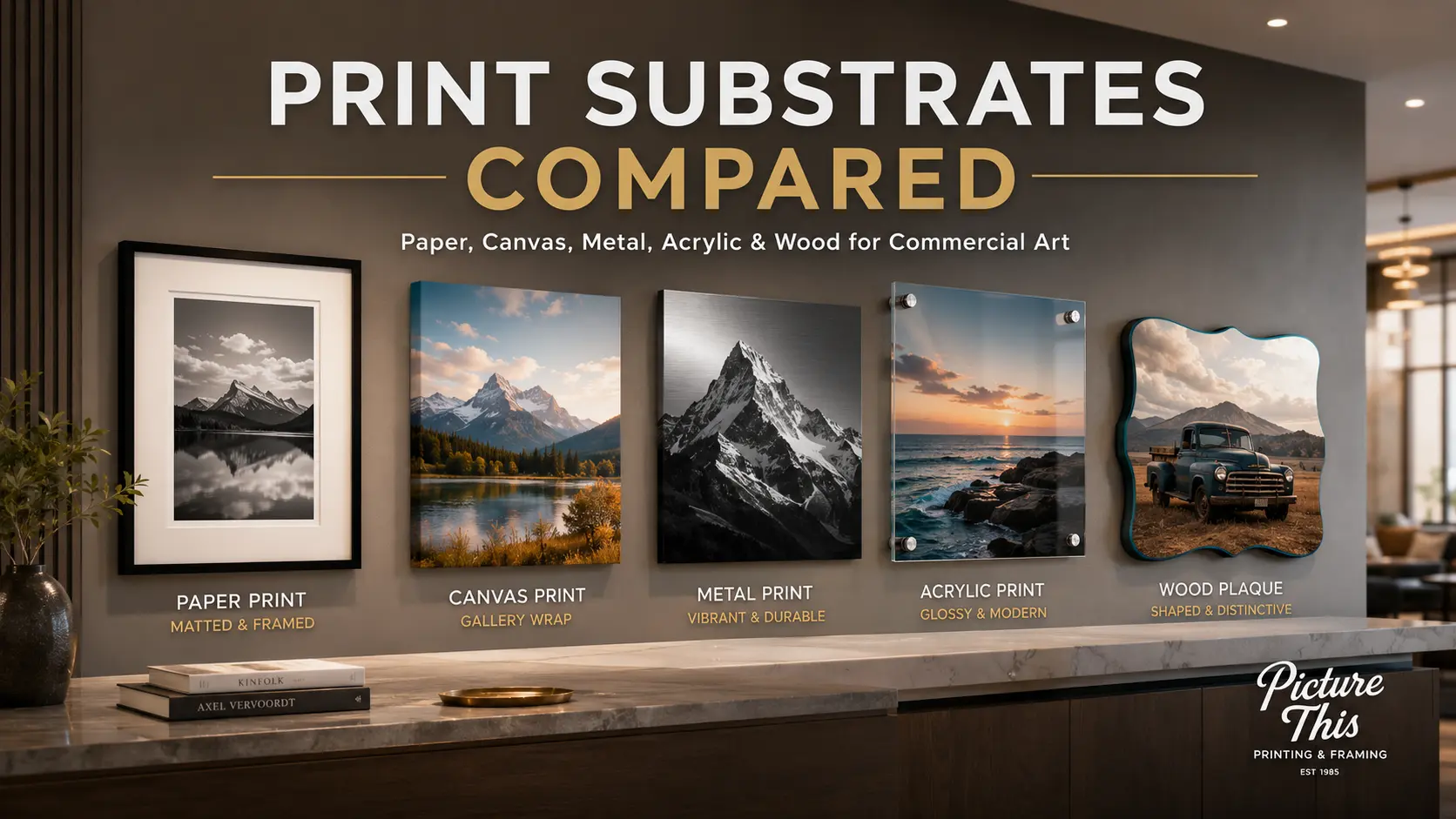
Substrate preference (paper, canvas, metal, acrylic)
Whether color proofing is required
If you are supplying finished prints or original art, note dimensions and media type so we can plan framing accordingly.
The Not-So-Obvious Stuff (Where Projects Get Derailed)
Here is where the real complexity lives — and where most RFPs fall short.
Budget Alignment with End Results
This is the single biggest factor that determines project success, and it is the one most often omitted from RFPs.
Designers specify materials. Procurement teams set budgets. These two things do not always align — and the vendor is usually the one who discovers the gap, often weeks into the process. (For real numbers on what programs actually cost by industry, see our Commercial Art Installation Cost Guide.)
Include your budget range in the RFP. This is not showing your hand. It is giving the vendor the information they need to propose something that actually works. A stated range lets us work backward: "For $85 per piece at 300 units, here is what you can achieve in frame, mat, and glazing." Without that number, we are guessing — and so is everyone else on your bid list.
The good news: we are very resourceful. We work with dozens of material vendors and can find creative ways to make visuals and budgets align. There are always options. But we need to know the constraint upfront to steer in the right direction immediately, rather than going through rounds of quoting and re-quoting.
Material Availability at Volume
This is the factor that surprises people most.
A beautiful moulding that works perfectly as a single sample may not exist in the quantity your program needs. When you get into hundreds or thousands of linear feet, most suppliers simply do not stock that readily. The moulding must be manufactured — and that changes everything:
Stock moulding: Ships in days. Price is predictable.
Made-to-order moulding: 6 weeks to 4+ months lead time. Price depends on run size and raw material costs.
Discontinued or limited-run profiles: May not be reproducible at any timeline or price.
This is why specifying a *look* (profile shape, finish, approximate width) gives your vendor dramatically more flexibility than specifying a single SKU. We can often find three or four options that match the visual intent — one of which is available in stock at the volume you need.
Higher quantities *can* drive per-unit prices down through batch efficiency. But that cost advantage only materializes if the materials are available. The two factors work together: volume pricing requires material planning.
Timeline
Timeline is not a scheduling detail — it is a pricing and feasibility factor.
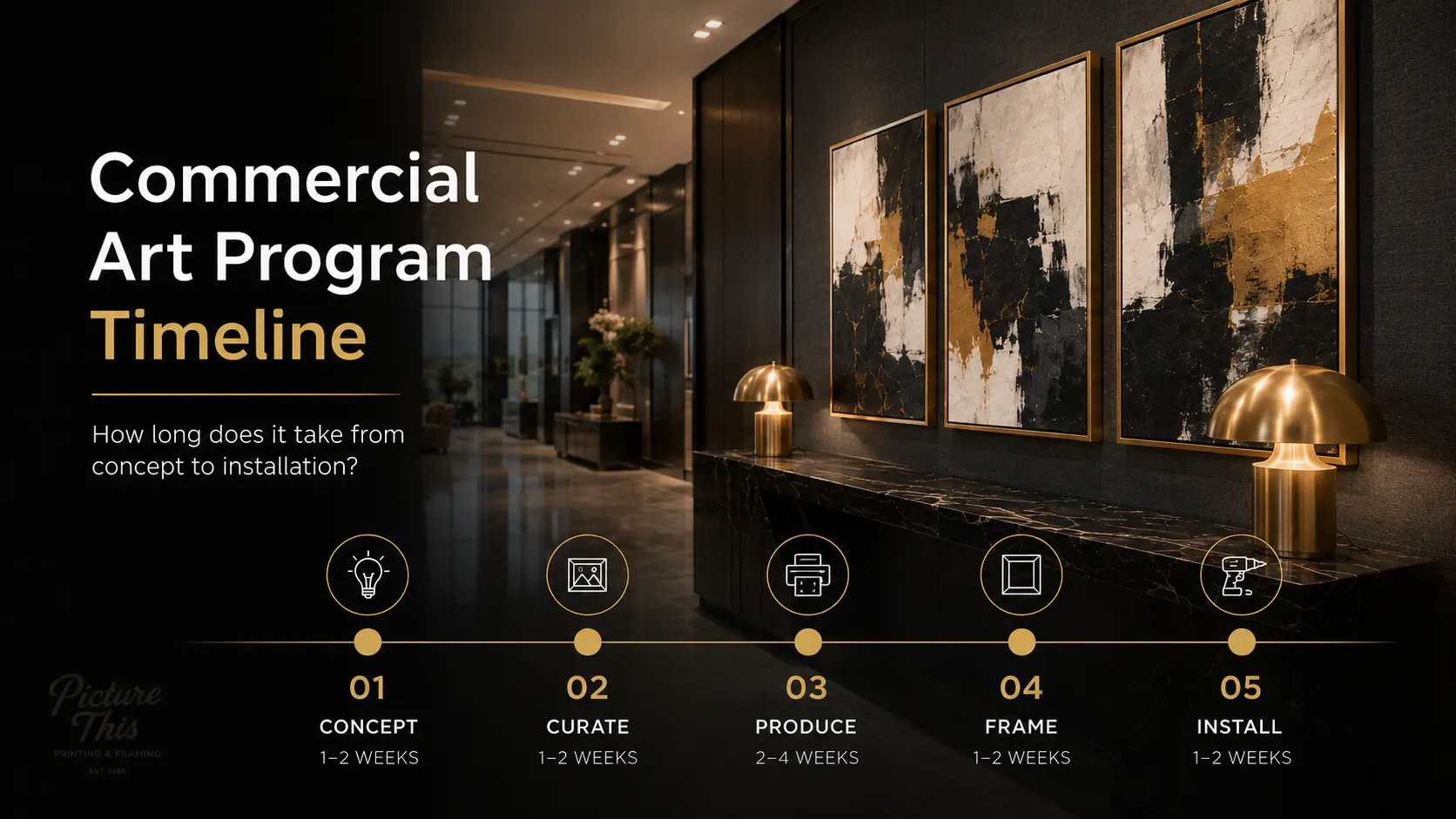
Here is what a realistic commercial framing timeline looks like:
| Phase | Duration |
|---|---|
| Material sourcing and dialing-in | 1–2 weeks |
| Moulding manufacturing (if required) | 6 weeks – 4+ months |
| Production (printing, framing, assembly, QC) | 2–6 weeks depending on quantity |
| Packaging and shipping | 3–10 days |
That means a program requiring manufactured moulding needs 3–6 months of lead time from approval to delivery. A program using stock materials can move in 3–5 weeks.
Put your install date in the RFP. If it is aggressive, say so — we will tell you what is achievable and what trade-offs exist. If it is flexible, say that too, because it opens up material options that a tight deadline would eliminate.
Rush timelines are not impossible, but they constrain choices. A vendor cannot manufacture moulding faster than the factory allows. What we *can* do is find in-stock alternatives that deliver the same visual result within your window.
The Complete RFP Checklist
Here is everything a commercial framing vendor needs to give you their best, most accurate quote:
Project Basics
Total piece count (broken out by area/tier if applicable)
Sizes (exact or approximate range)
Facility type and installation environment
Number of unique designs vs. repeated pieces
Materials & Design
Frame style direction (profile, finish, width — or reference images)
Matting specifications or "vendor recommend"
Glazing requirements (UV, shatter-resistant, anti-reflective, weight)
Print substrate (if vendor is printing)
Art files or licensing status
Budget & Business
Budget range per piece or total program budget
Whether budget is firm or flexible based on options
Payment terms expectations (net 30, deposits, milestone billing)
Timeline & Logistics
Target install date or delivery window
Ship-to location(s)
Installation scope (vendor-installed, installer-ready packaging, or client-handled)
Any phasing requirements (partial deliveries, priority areas first) — see our Phased Art Program Scaling Guide for planning multi-site rollouts
Other
Replacement inventory needs (typically 3–5% overage for hospitality and healthcare)
Sample or proof requirements before production
Any compliance requirements (fire rating, anti-ligature, infection control)
Example: What a Real Spec Sheet Looks Like
Most design teams organize their art programs in a spreadsheet — one row per piece (or group of identical pieces), with columns capturing every detail a vendor needs. Here is a simplified example showing how a 369-piece hotel program might be spec'd.
Part 1: Locations, Quantities, and Sizes
Swipe to see all columns
| Location | Description | Qty | Size | Printing |
|---|---|---|---|---|
| Lobby - Feature Wall | Statement abstract landscape | 1 | 48x36 | Vendor prints on fine art matte |
| Lobby - Seating Area | Botanical series | 4 | 24x30 | Vendor prints on lustre |
| Guest Rooms - King | Coastal abstract | 150 | 30x24 | Vendor prints on canvas |
| Guest Rooms - Suite | Oversized landscape | 25 | 48x32 | Vendor prints on fine art matte |
| Corridors - Floors 2-8 | Rotating abstracts (6 unique) | 84 | 20x24 | Vendor prints on satin |
| Restaurant - Dining | Local photography series | 8 | 36x24 | Vendor prints on lustre |
| Fitness Center | Motivational typography | 4 | 24x24 | Vendor prints on stretched canvas |
| Conference Room | Brand heritage timeline | 6 | 30x20 | Client-supplied prints |
| Spa - Treatment Rooms | Minimalist nature | 8 | 20x16 | Vendor prints on fine art matte |
| Pool Area (covered) | Tropical botanicals | 4 | 36x24 | Vendor prints on synthetic waterproof |
Part 2: Frame, Glazing, and Build Specs
Swipe to see all columns
| Location | Moulding | Glazing | Matting | Hardware |
|---|---|---|---|---|
| Lobby - Feature Wall | Modern float 2in face, satin black | Museum Glass (anti-reflective) | Float mount with spacers | French cleat |
| Lobby - Seating Area | Slim 1in face, warm walnut | UV OP3 Acrylic | White 4-ply | Security hangers |
| Guest Rooms - King | Composite 1.5in face, driftwood grey | Clear acrylic | White 4-ply | Security hangers |
| Guest Rooms - Suite | Hardwood 2in face, natural oak | UV OP3 Acrylic | Linen 8-ply | French cleat |
| Corridors - Floors 2-8 | Composite 1in face, matte black | Clear acrylic | White 4-ply | Security hangers |
| Restaurant - Dining | Slim metal, brushed brass | Non-glare acrylic | None - full bleed | French cleat |
| Fitness Center | Composite 1.5in face, matte black | Clear acrylic (shatter-resistant) | None - full bleed | Security hangers |
| Conference Room | Hardwood 2in face, dark espresso | Museum Glass | Double mat - cream over gold | French cleat |
| Spa - Treatment Rooms | Slim 0.75in face, white wash | Non-glare acrylic | White 4-ply | D-rings |
| Pool Area (covered) | Metal frame, powder coat white | UV OP3 Acrylic | None - full bleed | Stainless security |
Notice how the environment drives material decisions: the pool gets moisture-resistant metal frames with sealed backing. The fitness center gets shatter-resistant acrylic. Suites get premium hardwood and UV protection. Guest rooms get durable composite at a price point that works at 150 units. That logic should be visible in your spec sheet — it tells the vendor you have thought through the requirements, and it helps us confirm the right material is going to the right place.
The key columns every spec sheet needs:
Location / Area — tells the vendor the environment and visibility tier
Artwork reference — file name, thumbnail, or "client-supplied"
Quantity — per location or total
Dimensions — width x height of finished piece
Moulding — profile style, width, and finish
Glazing — type and any special requirements
Matting — color, ply, number of mats, or "none"
Hardware — security hangers, French cleats, D-rings, anti-ligature
Printing — vendor prints (on what substrate) or client-supplied
Download Our Spec Template
We have put together a spreadsheet template you can use as a starting point for your next art program. It includes all the columns shown above plus fields for budget, timeline, and shipping details at the bottom.
Download the Art Program Spec Template (CSV - opens in Excel/Google Sheets)
Fill in what you know, leave blanks where you need our guidance, and send it over. Even a partially completed template gives us enough to start a meaningful conversation about options.
What Happens When You Include All of This
When an RFP lands with complete information, here is what changes on our end:
We quote in days, not weeks. No back-and-forth clarification emails.
We propose options, not just a single number. "Here is your spec as written at $X per piece. Here is an alternative at $Y that gets you 90% of the look."
We flag feasibility issues immediately. If your timeline does not support your moulding choice, we tell you on day one — not after you have already committed.
We can value-engineer honestly. With a stated budget, we show you exactly where money goes and where we can trim without visible quality loss.
What We See Go Wrong
The most common RFP mistakes that cost programs time and money:
No budget stated. Every vendor guesses differently. You get incomparable bids.
SKU-level moulding specs without availability confirmation. The spec looks great until no one can source 3,000 feet of it.
Timeline omitted or unrealistic. "We need delivery in 4 weeks" for a program requiring custom moulding is not possible — but no one tells you until after award.
Mixing consumer framing expectations with commercial volumes. Retail custom framing shops work piece-by-piece. Commercial programs require production planning, material forecasting, and batch workflows. Different process, different pricing structure.
Design finalized without vendor input. A 15-minute conversation before the spec is locked can save weeks of re-quoting later. (Our guide on how to find a commercial framing vendor covers what to look for and what questions to ask.)
Our Team Makes Budgets and Visuals Work Together
After 40 years of commercial framing, this is what we do: find the intersection where the visual intent, the budget, and the timeline all meet. There are always options. The earlier we are in the conversation, the more options exist.
We are not the vendor who quotes one number and takes it or leaves it. We are the vendor who shows you three paths and helps you pick the one that serves the project best. That starts with you giving us the information to work with.
Ready to get a real quote? Call (714) 447-8749 or start your project here. Whether you have a complete spec package or just a napkin sketch and a budget number, we can work with it.
Related Services
Industries We Serve
Questions About Your Project?
Our team in Fullerton is here to help with commercial art installations, custom framing, and museum-quality printing. Call us or request a quote to discuss your specific needs.