Print Substrates Compared: Why Fine Art Paper + Custom Framing Outperforms Metal, Acrylic, Canvas & Wood for Commercial Art Programs
A side-by-side comparison of print substrate options for commercial art programs. Paper + custom framing wins on archival life, replaceability, cost of ownership, and design flexibility. See where metal, acrylic, canvas, and plaque-mounted wood actually make sense — and where they fall short.
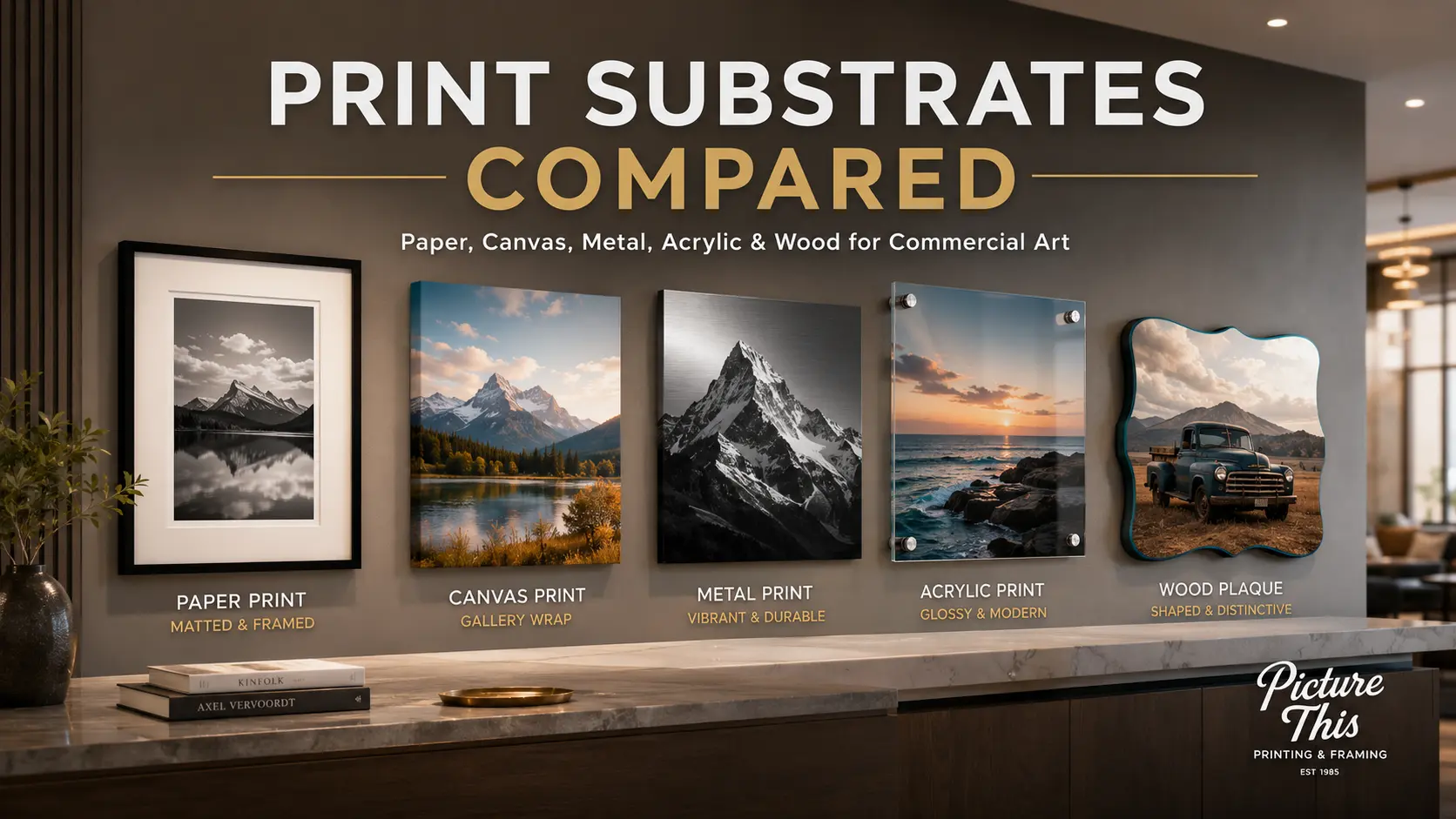
The short answer: Fine art paper printed with archival pigment inks and custom-framed behind UV-protective glazing is the right choice for 80–90% of pieces in a commercial art program. It offers the longest proven lifespan, the widest aesthetic range, the fastest production speed, the lowest total cost of ownership, and — critically — the only substrate that allows single-piece replacement without reproducing the entire assembly. The other substrates (canvas, metal, acrylic face-mount, plaque-mounted wood) serve specific niche applications, but none of them match paper + framing on the combination of longevity, versatility, replaceability, and value at volume.
We produce all five substrates at our Fullerton facility and have delivered commercial programs on every one of them. This guide compares them honestly so you can make an informed decision — but our recommendation is clear: start with paper and framing as your program foundation, then layer in alternative substrates only where specific environmental conditions demand them.
Why Substrate Choice Matters for Commercial Programs
The substrate is not just what the image sits on — it determines:
How the piece is presented (framed, floated, frameless, mounted)
How long it lasts under real commercial conditions
How it's maintained by housekeeping and facilities teams
What it costs when you factor in framing, glazing, and hardware
How it's replaced when damage occurs years later
Consumer printing conversations focus on "which looks prettiest." Commercial programs need to answer: which survives 7–15 years on a hotel corridor wall getting bumped by housekeeping carts, wiped down weekly, and lit 16 hours a day? And when a piece does get damaged in year 5, which substrate lets you fix the problem for $30 and 15 minutes — versus $150+ and a 2-week lead time?
That replaceability factor is why fine art paper behind glazing dominates commercial programs at every scale.
The Complete Substrate Comparison
At a Glance: Performance by Factor
Swipe to see all columns
| Factor | Fine Art Paper | Canvas | Metal | Acrylic Face-Mount | Wood (Plaque Mount) |
|---|---|---|---|---|---|
| Archival life | 100+ years | 25–50 years | 50–75+ years | 50–75+ years | 20–40+ years |
| UV resistance | Depends on glazing | Moderate (with varnish) | High (dye-sub) | Moderate | Moderate |
| Moisture tolerance | Low (needs sealed frame) | Low–Moderate | Excellent | Excellent | Low–Moderate |
| Impact resistance | Protected by glazing | Moderate (can puncture) | Moderate (can dent) | Low (can crack on edge) | Moderate (can chip) |
| Weight | Medium (with frame) | Light–Medium | Light | Medium | Light |
| Requires framing | Yes | Optional | No | No | No |
| Cleanability | Glazing surface | Varnish surface | Wipe-clean | Wipe-clean | Sealed surface |
| Repairability | Reprint and reframe | Difficult | Replace only | Replace only | Replace only |
| Color gamut | Widest | Wide | Wide (vivid) | Widest (backlit effect) | Moderate |
| Texture options | Many (matte, satin, luster, velvet) | Natural weave | Smooth metallic | Glass-smooth | Wood grain or opaque |
At a Glance: Cost and Application
Swipe to see all columns
| Factor | Fine Art Paper | Canvas | Metal | Acrylic Face-Mount | Wood (Plaque Mount) |
|---|---|---|---|---|---|
| Media cost per piece | $ | $ | $ | $ | $ |
| Total installed cost | $ – $ (includes frame + glazing) | $ – $ | $ – $ (no frame needed) | $ | $ (no frame needed) |
| Best environment | Hotels, healthcare, corporate, any | Hotels, restaurants, residential-feel | Modern corporate, restaurants, pools | Luxury lobbies, galleries, feature walls | Casual hospitality, breweries, co-working |
| Worst environment | Unframed in humidity | High humidity, maritime | Traditional/formal interiors | High-traffic corridors (edge chips) | High humidity, maritime |
| Production speed at volume | Fastest | Moderate (stretching/mounting) | Moderate | Slow (curing time) | Moderate |
| Minimum order for volume pricing | 50+ pieces | 50+ pieces | 25+ pieces | 10+ pieces | 25+ pieces |
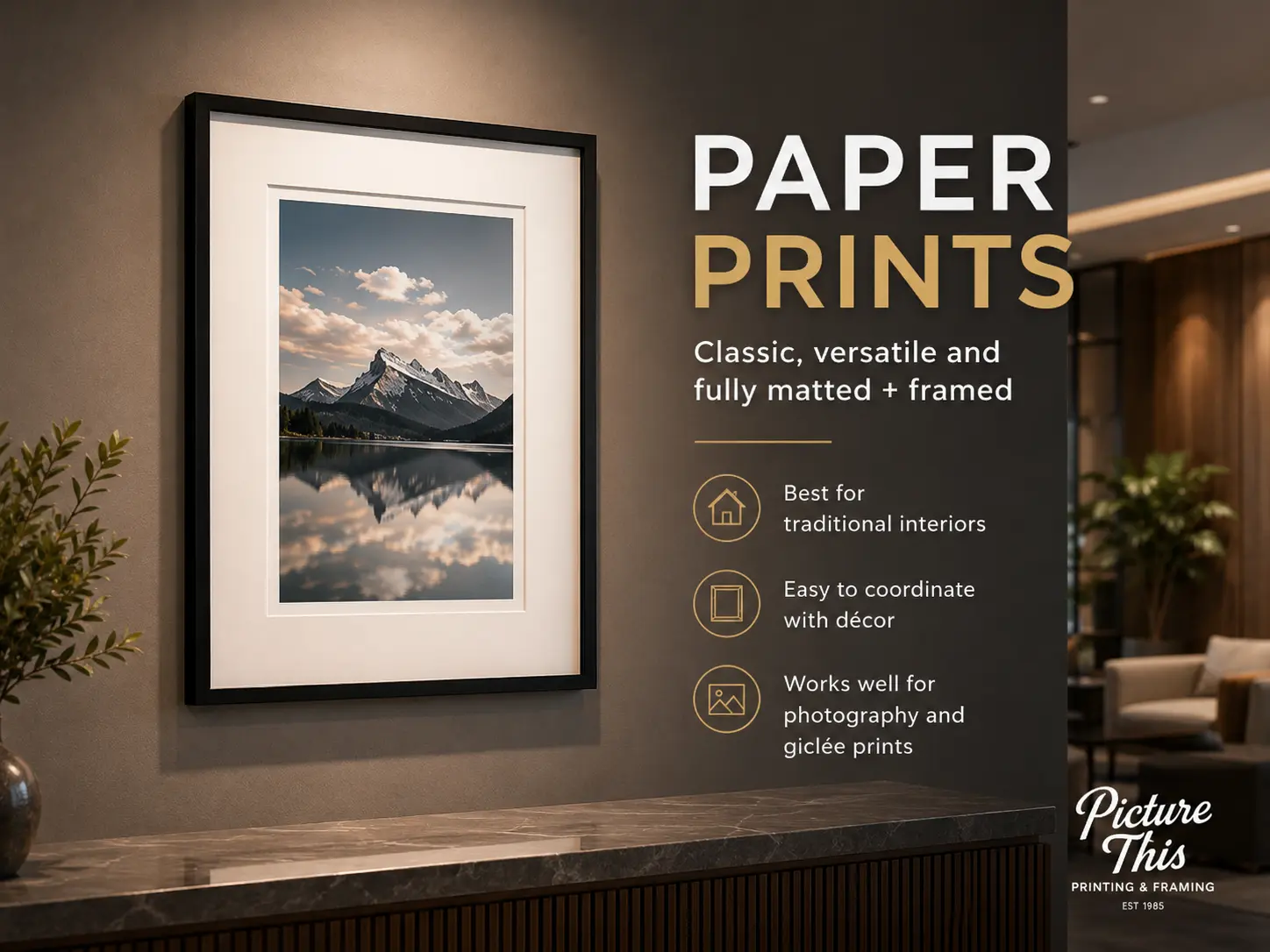
Fine Art Paper + Custom Framing: The Commercial Standard (and Our Recommendation)
Fine art paper behind glazing is the most-specified substrate in commercial art programs — and for good reason. After producing thousands of programs across every substrate, our recommendation is unequivocal: paper + framing is the superior choice for the vast majority of commercial applications. It's not close.
What it is: Archival pigment ink printed onto premium cotton rag or alpha-cellulose paper, then matted, mounted, and custom-framed behind protective glazing.
Why it dominates commercial programs (and why we recommend it):
Finish range. Matte, satin, luster, velvet, metallic — each reads completely differently. A single program can use luster in guest rooms and velvet in executive suites without changing the frame spec. No other substrate offers this range within a single medium.
Archival performance. 100+ years rated with archival pigment inks on acid-free paper. Nothing else comes close on proven longevity. Your investment is protected for decades.
Complete design flexibility. Works with any frame profile, any mat, any glazing. The substrate disappears behind the presentation — which means the design conversation is about aesthetics, not substrate limitations. You're never constrained.
Replacement simplicity — the decisive advantage. Damaged piece? Reprint the file, re-cut the mat, re-use the frame. $25–$45 and same-day turnaround. Every other substrate requires full reproduction of the entire piece ($80–$250+) with multi-day to multi-week lead times. On a 300-room hotel program, this difference compounds into tens of thousands of dollars in lifecycle savings.
Production speed. Our large-format printers produce fine art paper prints faster than any other substrate. At 500+ pieces, that speed compounds into meaningful timeline advantages — often shaving 2–4 weeks off project delivery compared to metal or acrylic.
Quality control. We print, mount, mat, glaze, and frame every paper piece in our own Fullerton facility. Full control of the process from file to finished piece means consistent color, consistent quality, and fast response when revisions are needed.
Program scalability. Paper + framing scales linearly. A 50-piece program and a 5,000-piece program use the same process. Frameless substrates often hit production bottlenecks at volume that extend timelines and introduce quality variation.
Where paper requires care:
Paper is moisture-sensitive and must be sealed behind glazing in any environment with sustained humidity — pool areas, spa wet zones, and maritime installations. In these specific environments (typically 5–10% of a program's pieces), an alternative substrate is warranted. For the other 90–95% of placements in controlled indoor environments, the sealed frame package provides complete protection while delivering superior aesthetics and lifecycle economics.
Papers we work with: Vibrance Luster, Vibrance Satin, Vibrance Metallic Gloss, Signa Smooth, Elegant Velvet, and others — each selected for the specific visual intent and environment. For a deeper look at paper selection and what "museum-quality" actually means, see our Museum-Quality Printing guide.
Pair with: UV OP3 Acrylic glazing for most commercial programs. Claryl Museum Glass for premium focal pieces.
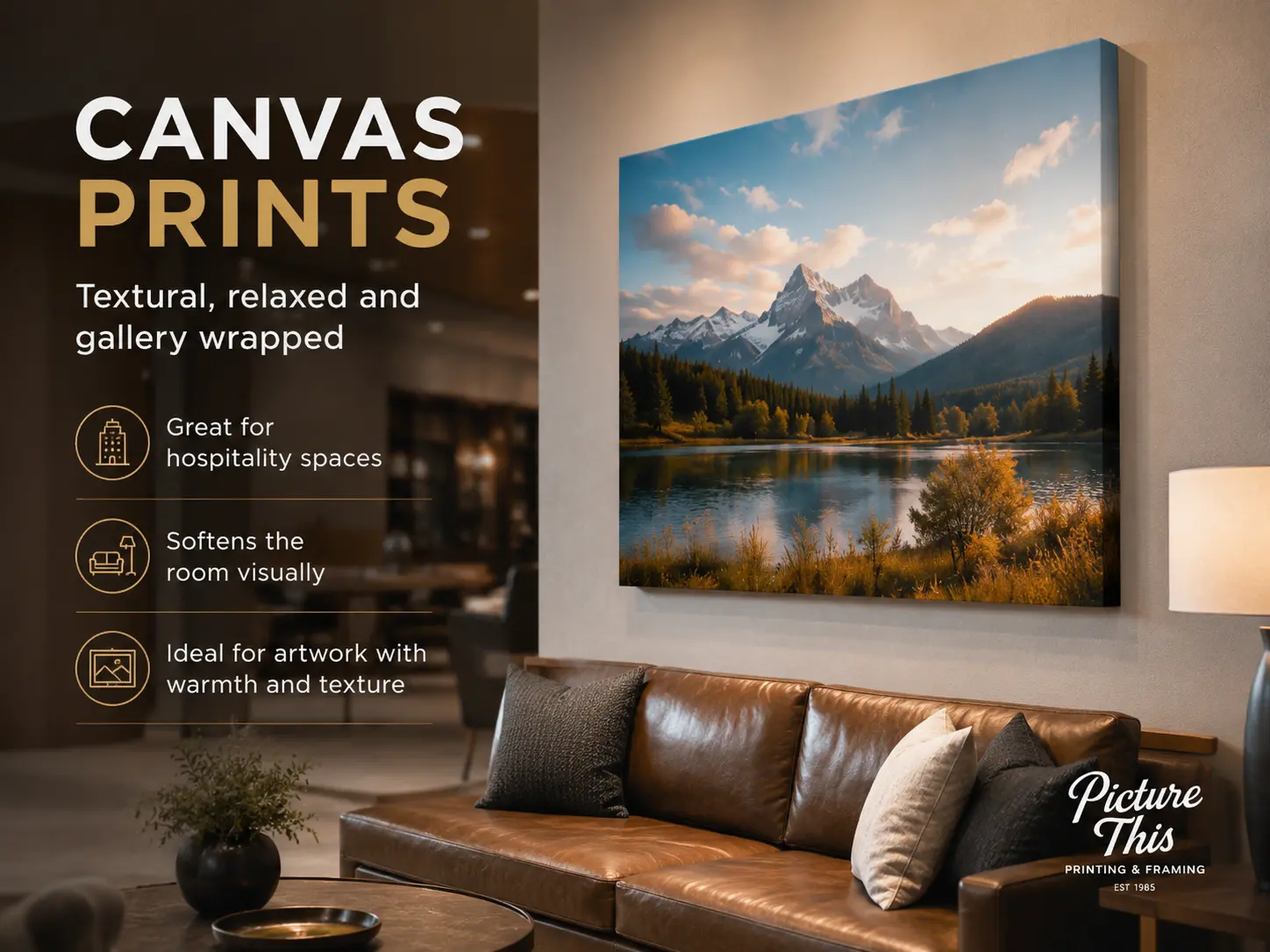
Canvas: Warmth and Texture
Canvas prints bring a tactile, painterly quality that paper cannot replicate. When a program calls for warmth, depth, or an art-gallery aesthetic without the formality of traditional framing, canvas is the answer.
What it is: Archival pigment ink printed onto poly-cotton or cotton canvas, then either gallery-wrapped (stretched over bars), float-mounted to a panel, or framed traditionally.
Where canvas excels:
Texture. The woven surface adds visual depth that reads as "painted" rather than "printed" — even from several feet away. This matters for hospitality brands positioning as artisanal or elevated-casual.
Versatility of presentation. Gallery-wrap eliminates frame cost entirely. Float-frame adds a modern reveal. Traditional framing works equally well.
Weight. A gallery-wrapped canvas is significantly lighter than an equivalent framed-and-glazed paper print. At high volume, this reduces shipping costs and simplifies installation hardware.
Dining environments. Canvas with UV-protective varnish performs well in restaurants where the warmer aesthetic fits and glazing reflections from ambient lighting would be distracting.
Where canvas has limits:
Longevity. Even varnished, canvas doesn't match paper-behind-glazing on archival life. Expect 25–50 years depending on light exposure and environmental conditions.
Puncture risk. Stretched canvas is vulnerable to puncture from sharp impacts — a concern in high-traffic hotel corridors and healthcare environments.
Cleaning. Varnished canvas can be lightly dusted but doesn't tolerate wet cleaning or disinfectant wipes. Not appropriate for healthcare patient areas where infection-control cleaning is required.
Humidity. Canvas stretches and contracts with humidity changes. In pool areas, cruise ships, or any high-humidity environment, canvas will sag and wrinkle over time.
Cost context: Canvas media costs roughly 30–50% more than equivalent fine art paper, plus stretching or mounting labor. However, gallery-wrapped presentation eliminates frame and glazing costs — which can make total installed cost equal to or lower than framed paper for certain program configurations.
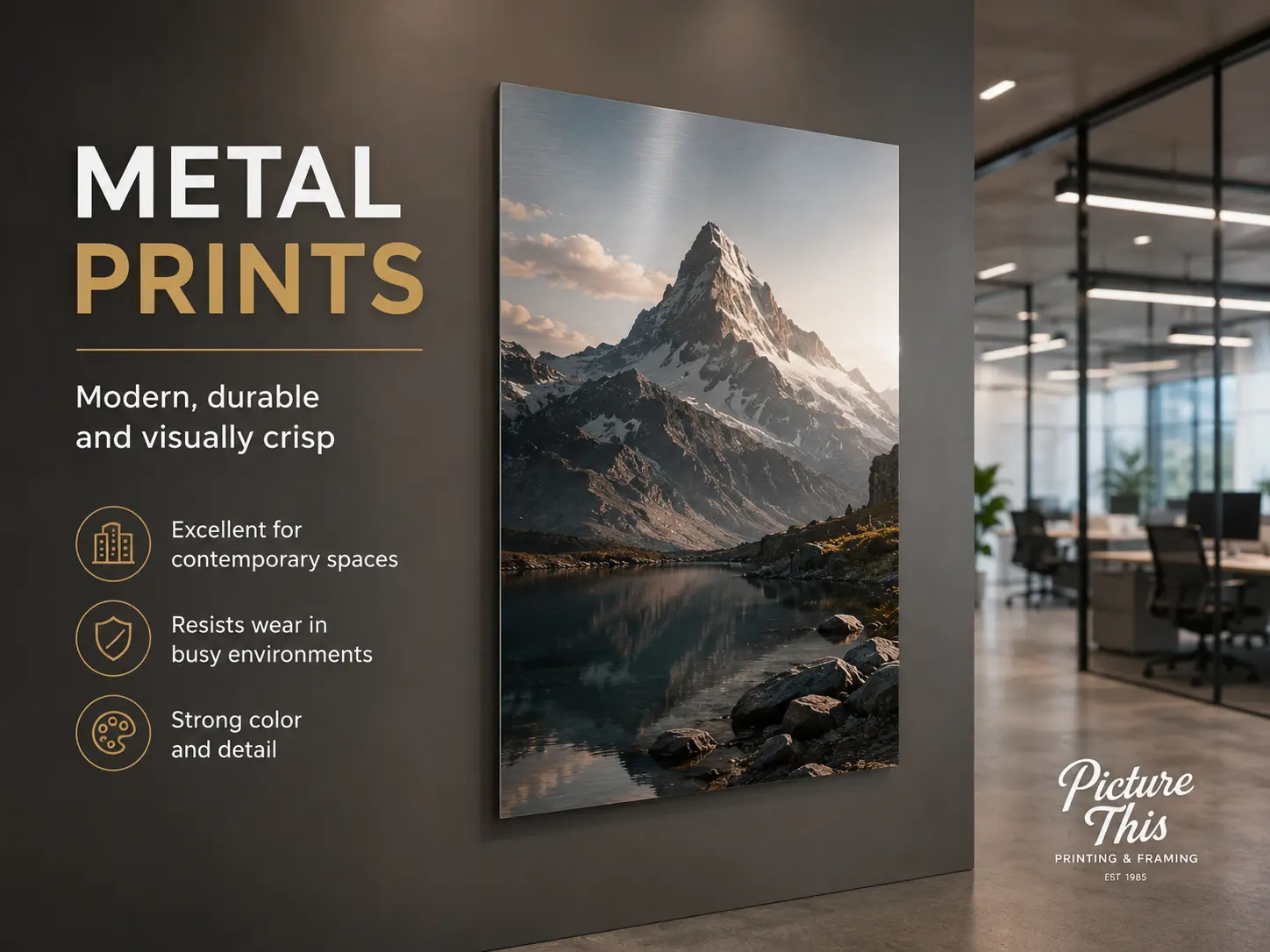
Metal Prints: The Moisture-Zone Specialist
Metal prints serve a specific niche: environments where sustained moisture exposure makes framed paper impractical. They are not a general-purpose alternative to paper + framing — they're a specialized solution for specialized conditions.
What it is: A photographic image infused into a specially coated aluminum panel via dye-sublimation heat transfer. The metal surface becomes the image — it's not a layer on top.
Where metal is appropriate:
Moisture-exposed areas. Pool decks, spa corridors, restaurant bar adjacencies near sinks/ice, and cruise ship installations. These are environments where paper genuinely cannot perform, and metal is the correct answer.
Frameless modern aesthetic (limited applications). When a specific design concept requires frameless presentation in a contemporary space — typically a tech lobby or modern restaurant feature wall.
Where metal falls short compared to paper + framing:
Irreparable damage. Aluminum dents on hard impact. A housekeeping cart striking a metal print creates permanent damage — the entire piece must be reproduced. On a framed paper program, you'd reprint for $30 and swap in 15 minutes. This single factor makes metal a poor choice for high-traffic hotel corridors.
Cold aesthetic. Metal reads modern, clinical, cool. Most hospitality environments — hotels, senior living, healthcare, traditional corporate — need warmth that metal cannot deliver.
Reflection problems. The metallic surface creates significant glare under direct lighting. Paper behind anti-reflective glazing eliminates this entirely.
Limited finish range. You get metallic glossy, metallic satin, or white-base matte. Paper offers 9+ distinct finishes for fine-tuning the visual intent.
Longer lead times. Metal production runs slower than paper printing. At volume, this extends project timelines by 2–4 weeks.
Color inconsistency at volume. Dye-sublimation panels can vary batch-to-batch. Paper printing delivers tighter color consistency across large runs.
Best applications: Pool areas, spa wet zones, cruise ship interiors, outdoor-adjacent covered spaces, restaurant bars — anywhere sustained moisture makes sealed paper framing impractical. Typically 5–15% of a program's total pieces.
Our honest assessment: Metal prints have a role, but it's a narrow one. When designers specify metal for an entire hotel program because it "looks modern," the client ends up with higher upfront costs, irreparable damage in corridors, and 3x replacement costs for the life of the program. We'll recommend metal where conditions demand it — and recommend paper everywhere else. For pricing context, see our Commercial Art Installation Cost Guide.
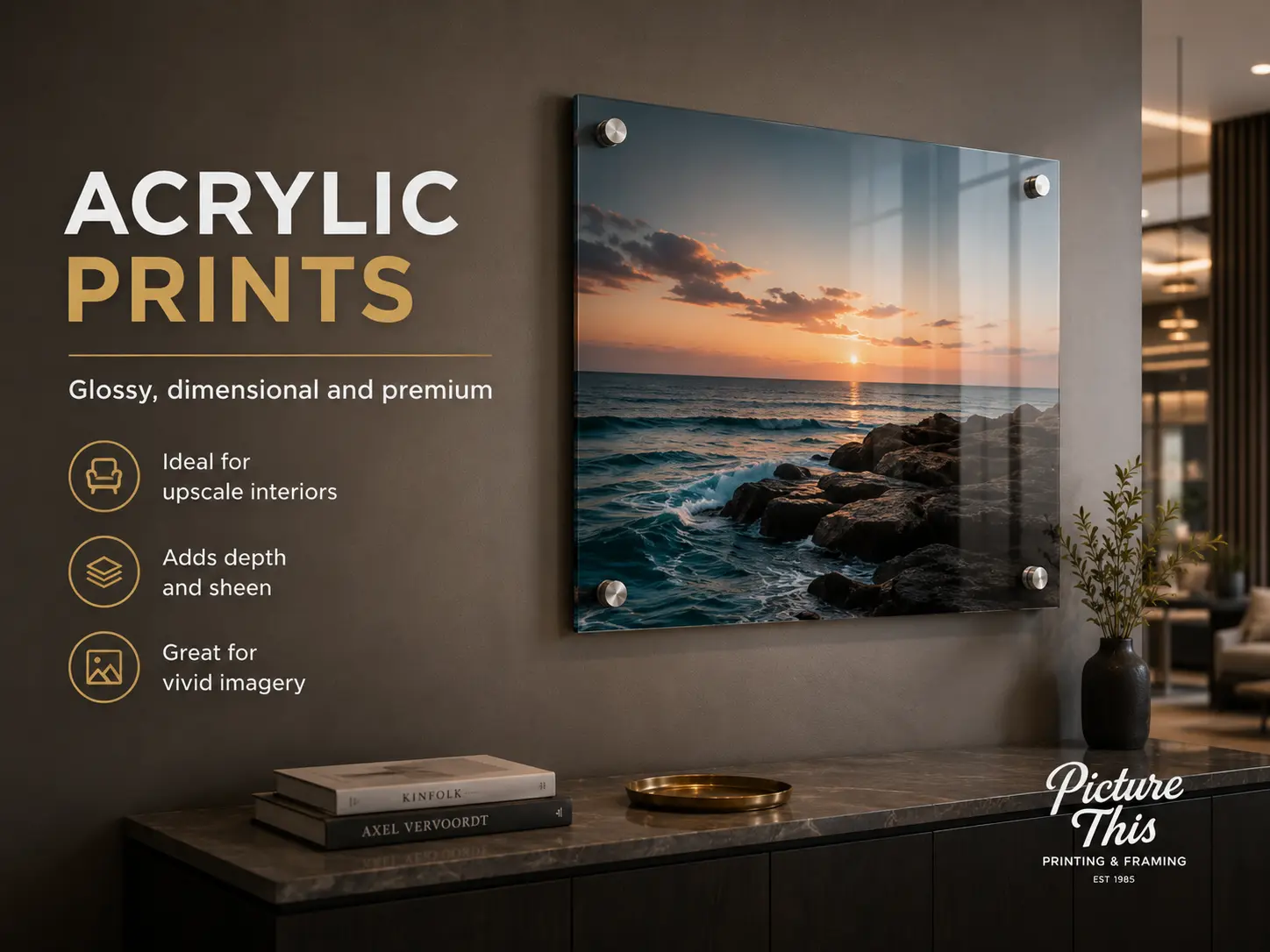
Acrylic Face-Mount: Statement Pieces Only
Acrylic face-mount prints produce a dramatic, luminous visual impact — but at 3–5x the cost of framed paper with no repair path and significant practical limitations. They have a place in commercial programs, but that place is very narrow: 1–4 hero pieces per property, not volume specification.
What it is: A photographic print (typically on metallic or luster paper) bonded face-down to the back of a polished acrylic panel using optically clear adhesive, then backed with aluminum composite for rigidity. The viewer sees the image through the acrylic, which acts as both protector and optical enhancer.
Where acrylic face-mount is appropriate:
Single statement pieces in luxury lobbies or executive reception where one dramatic focal piece justifies the premium.
Gallery exhibitions where visual impact outweighs lifecycle cost considerations.
Why acrylic face-mount is wrong for most commercial applications:
Cost. The most expensive substrate by a significant margin. 3–5x the cost of a framed paper print. At volume, this cost difference is program-breaking.
Irreparable. Any damage — edge chip, surface scratch, mounting failure — requires full reproduction of the entire piece. No partial repair possible. With framed paper, you reprint for $30.
Edge vulnerability. Acrylic chips on edge impact. In any corridor, elevator lobby, or public space where luggage, carts, or people contact the wall, chipped edges are inevitable and irreparable.
Fingerprints and maintenance. The polished surface shows every fingerprint and requires constant cleaning attention. Housekeeping teams flag this as a maintenance burden.
Weight. The acrylic-plus-aluminum sandwich is significantly heavier than framed paper. Large pieces require specialized mounting hardware and structural wall backing.
Production time. Bonding and curing adds weeks to production timelines. A 20-piece acrylic order takes longer than a 200-piece paper program.
Limited aesthetic range. You get one look: glossy, luminous, contemporary. Paper + framing offers infinite aesthetic variation through finish, mat, and frame selection.
Our honest assessment: Acrylic face-mount is impressive for 2–3 lobby statement pieces. Beyond that, it's an expensive liability. We've seen programs specify acrylic for 50+ pieces and regret it within 18 months when the first edge chips appear and replacement quotes arrive at $200+ per piece. A well-framed fine art paper print behind Claryl Museum Glass achieves 90% of the visual impact at 40% of the cost with a fraction of the replacement risk.
Best applications: Limit to 1–4 hero pieces per property in protected, low-traffic locations at heights above casual contact. Budget the same amount again for a 10-year replacement fund.
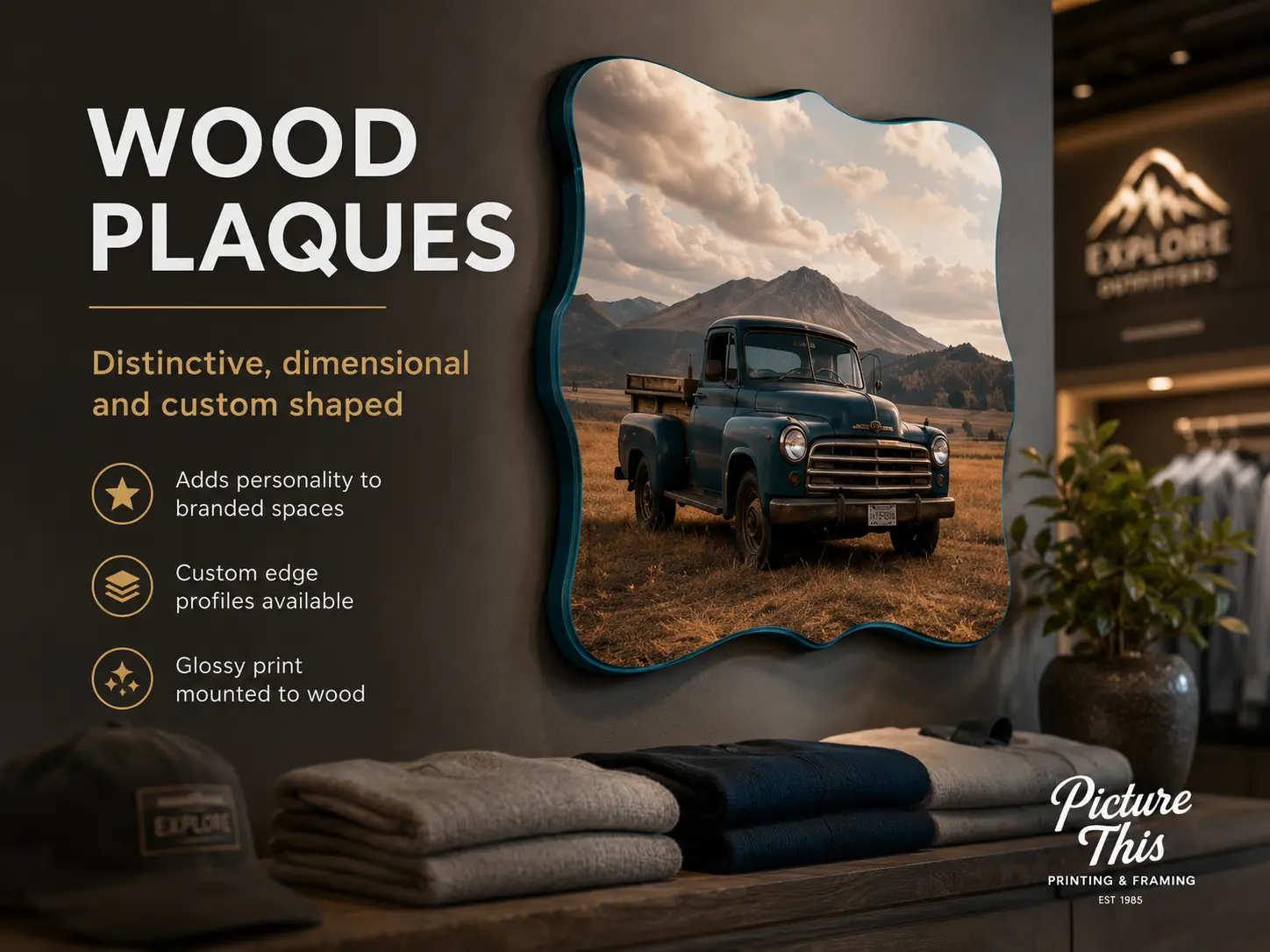
Wood Plaque Mounts: Niche Casual Applications
Wood plaque mounts fill a narrow aesthetic niche for casual, craft-forward environments. They're not a serious alternative to paper + framing for most commercial programs, but they have legitimate applications where the brand identity is explicitly rustic or artisanal.
What it is: An image printed using UV-cured or dye-sublimation ink onto a sealed, lightweight wood panel. Plaque mounting uses engineered wood substrates for consistency and reduced weight. The wood grain can show through lighter areas of the image as a design feature, or the surface can be fully opaque depending on the print process.
Where wood plaque mounts are appropriate:
Craft breweries and taprooms where the rustic aesthetic is brand-aligned
Casual and fast-casual restaurants with natural/organic brand positioning
Vacation rentals and casual lobbies seeking a relaxed, distinctive vibe
Why wood is wrong for most commercial programs:
Moisture sensitivity. Despite sealing, wood substrates warp and delaminate under sustained moisture exposure. Not suitable for hospitality wet zones, maritime, or any humid environment.
Color reproduction limits. The wood surface cannot match the color accuracy and gamut of paper. Subtle tonal gradations shift. Brand colors drift. For programs requiring color precision, wood fails.
No archival track record. Wood print technology is too new for confident long-term performance claims. Paper behind glazing has 100+ years of proven data.
Not replaceable or repairable. Like metal and acrylic, a damaged wood print is a total loss. The entire piece must be reproduced.
Reads too casual for most commercial environments. Wood prints don't belong in hotels, healthcare, corporate offices, or any environment where professional presentation matters.
Limited profile range. You get the panel edge as your "frame." The design flexibility is a fraction of what traditional framing offers.
Our honest assessment: Wood plaque mounts are a nice accent for the right brand in the right environment. But if we're being direct: for every 100 programs we produce, maybe 2–3 warrant wood pieces, and even those programs still use paper + framing for 60–70% of their pieces. It's a flavor, not a foundation.
Best applications: Breweries, taprooms, casual restaurants with natural brand positioning, vacation rentals, co-working spaces. Typically as accent pieces alongside a paper + framing foundation.
Substrate Recommendations by Environment
Swipe to see all columns
| Environment | Our Recommendation | Acceptable Alternative | Avoid |
|---|---|---|---|
| Hotel guest rooms | Fine art paper (framed, OP3 acrylic) | Canvas (gallery-wrap) | Metal (cold), acrylic (cost), wood (casual) |
| Hotel lobby | Fine art paper (Claryl Museum Glass, premium frame) | Acrylic face-mount (1–2 hero pieces max) | Wood (too casual) |
| Hotel corridors | Fine art paper (framed, OP3 acrylic) | — | Metal (dents from carts), acrylic (edge chips) |
| Corporate reception | Fine art paper (Museum Glass, float-frame) | Metal (tech brands only) | Wood (too casual) |
| Corporate offices | Fine art paper (framed) | Canvas (creative firms) | Metal (cold for daily work environment) |
| Healthcare patient areas | Fine art paper (sealed frame, acrylic glazing) | — | All frameless options (infection control) |
| Restaurant dining | Fine art paper (framed) or canvas | Wood (casual concepts only) | — |
| Restaurant bar (moisture zone) | Metal | — | Paper (moisture), canvas (moisture) |
| Cruise ship | Metal | Fine art paper (sealed frame, acrylic) | Wood, canvas (humidity) |
| Pool / spa wet areas | Metal | — | Paper, canvas, wood (moisture) |
| Pool / spa dry areas | Fine art paper (framed, sealed) | Metal | Canvas, wood |
| Co-working / creative | Fine art paper (framed) | Canvas or wood accent pieces | Acrylic (cost) |
| Senior living | Fine art paper (framed) | Canvas | Metal (cold), acrylic (fragile edges) |
Total Cost of Ownership: Why Paper + Framing Wins
Unit media cost is misleading. Frameless substrates appear cheaper because they eliminate framing — but their higher media costs and zero repairability make them more expensive over the life of a program. Here’s how total cost compares for a typical 24x36" commercial piece:
Swipe to see all columns
| Cost Component | Fine Art Paper (Framed) | Canvas (Gallery-Wrap) | Metal Print | Acrylic Face-Mount | Wood Print |
|---|---|---|---|---|---|
| Print/media | $20–$45 | $35–$65 | $70–$130 | $120–$220 | $50–$90 |
| Frame | $35–$120 | $0 (or $30–$80 float) | $0 | $0 (or $40–$100 optional) | $0 |
| Glazing | $25–$70 | $0 | $0 | $0 | $0 |
| Mat/mount | $15–$40 | $10–$25 (stretching) | $0 | $0 | $0 |
| Hardware | $8–$20 | $8–$15 | $10–$25 (float mount) | $15–$35 (French cleat) | $8–$20 |
| Total installed | $103–$295 | $53–$170 | $80–$155 | $135–$255 | $58–$110 |
| Replacement cost | Reprint only ($20–$45) | Full piece | Full piece | Full piece | Full piece |
The replacement advantage of framed paper is decisive. When a hotel corridor piece gets damaged in year 5, a paper-and-frame program needs a new $30 print and 15 minutes of assembly. A metal or acrylic program needs an entirely new piece produced and shipped — $100–$250 and 1–3 weeks. On a 300-room hotel program expecting 5–10% replacement over 10 years, that’s the difference between $5,000 in lifecycle maintenance versus $30,000+.
Over a 10-year lifecycle for a 200-piece program: Fine art paper + framing saves approximately $15,000–$40,000 in replacement costs compared to an all-metal or all-acrylic program — while delivering superior archival performance and design flexibility.
For a comprehensive look at how these substrate costs fit into full program budgets, see our Commercial Art Installation Cost Guide.
Mixing Substrates Within a Program
The strongest commercial programs use paper + framing as the foundation (80–95% of pieces) and layer in alternative substrates only where conditions demand it:
A typical luxury hotel program (our recommendation):
Lobby feature wall: Fine art paper behind Claryl Museum Glass in premium float-frames (maximum visual impact with full replaceability) — or 2–3 acrylic face-mount if the design concept requires it
Guest rooms: Fine art paper on luster or satin, framed with UV OP3 acrylic glazing (archival, replaceable, volume-friendly)
Corridors: Fine art paper, framed (durability behind glazing, lowest replacement cost for the highest-traffic area)
Pool and spa wet areas only: Metal prints (the one place they’re necessary)
Restaurant dining room: Fine art paper or canvas, framed (warm, replaceable)
Restaurant bar (behind sinks): Metal (moisture zone)
A casual hospitality or co-working program:
Everything except wet areas: Fine art paper, framed with appropriate finish and moulding (professional, versatile, replaceable)
Accent/feature wall (brand moment): Canvas gallery-wrap or 2–3 wood plaque-mount pieces if brand identity is explicitly rustic
Wet areas only: Metal
Notice the pattern: paper + framing handles 80–95% of every program. The alternative substrates fill gaps where moisture or a very specific design concept demands them. This approach optimizes budget, simplifies maintenance, and builds a program that’s easily refreshable for decades. For guidance on specifying this in your RFP, see our Art Spec Package guide.
What We See Go Wrong
The most common substrate mistakes on commercial programs:
Over-specifying metal or acrylic for volume. Designers love how metal and acrylic look in a portfolio — but programs that specify these for 100+ pieces face 3x replacement costs, longer timelines, and irreparable damage accumulation. Use them for the 5–10% of pieces in moisture zones or hero walls. Paper + framing handles the other 90–95% better in every measurable way.
Specifying canvas for healthcare. Canvas cannot be disinfected with hospital-grade cleaners. Infection prevention committees will reject it. Use sealed paper behind acrylic glazing instead. See our Healthcare Art Programs guide for proper specifications.
Metal prints in hotel corridors without considering cart traffic. Metal dents permanently. If the corridor sees housekeeping carts, luggage carts, or food service carts, the pieces will accumulate damage that cannot be repaired. Framed paper behind acrylic glazing is scratch-resistant and replaceable.
Acrylic face-mount at touching height or in corridors. Fingerprints. Edge chips. Constant maintenance. Limit acrylic to protected lobby positions above 5' height.
Wood prints in humid environments. Despite sealing, wood substrates are engineered for dry, controlled indoor environments only.
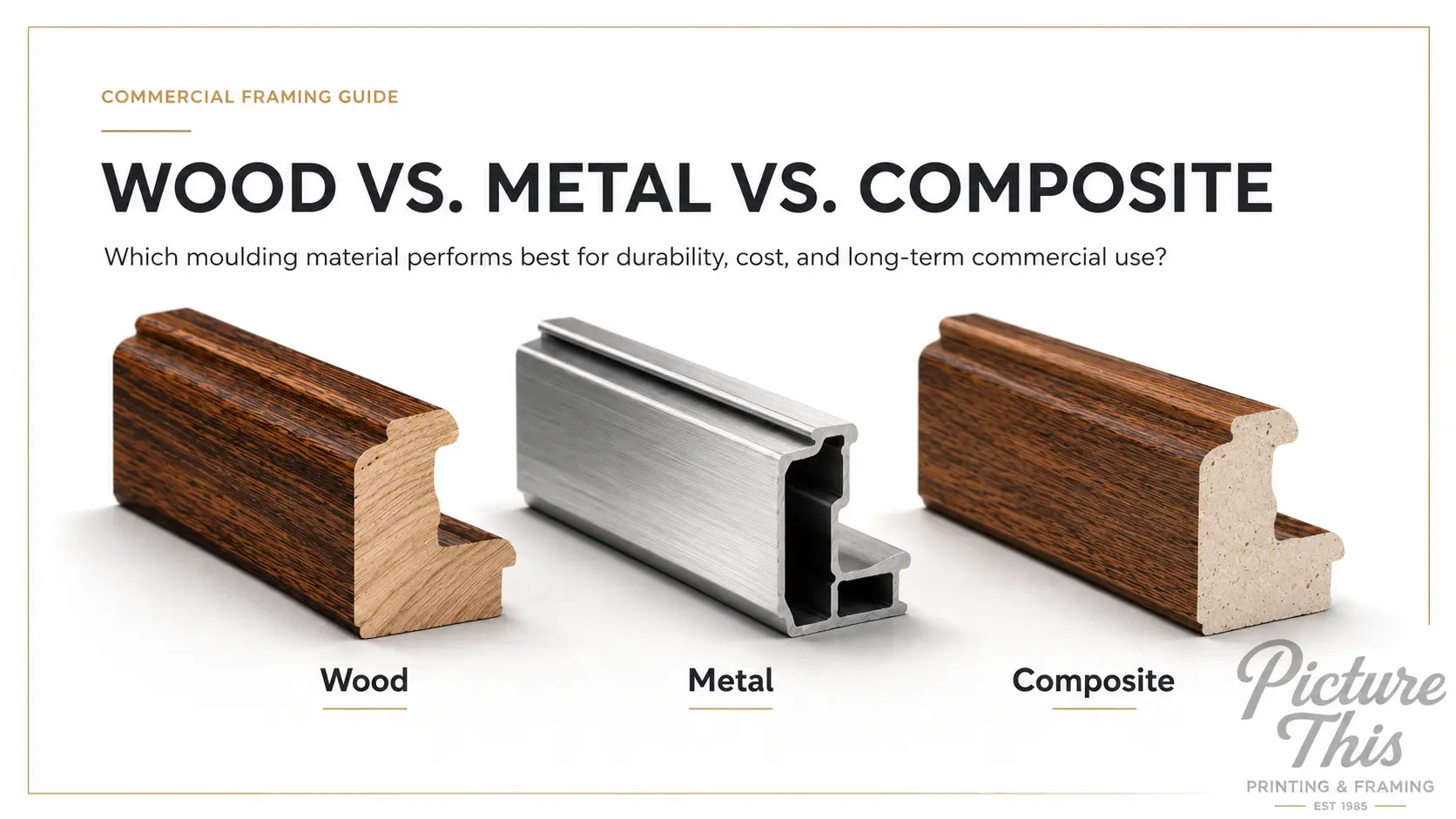
Choosing substrate before choosing frame. For paper and canvas, the frame and glazing combination is what the viewer sees first. The substrate decision should be made in context with framing — not independently. Our Moulding Comparison Guide covers frame material options in detail.
Assuming frameless saves money. Metal and acrylic face-mount eliminate frame costs but carry higher media costs and zero repairability. At volume (200+ pieces), framed fine art paper is almost always lower total installed cost AND lower lifecycle cost than any frameless option. Frameless is a niche aesthetic choice, not a budget play.
Substrate and Glazing: The Combined Decision (Paper’s Secret Weapon)
The ability to pair fine art paper with different glazing options is one of its biggest advantages over every other substrate. You can fine-tune the visual presentation, UV protection level, and price point piece by piece within the same program:
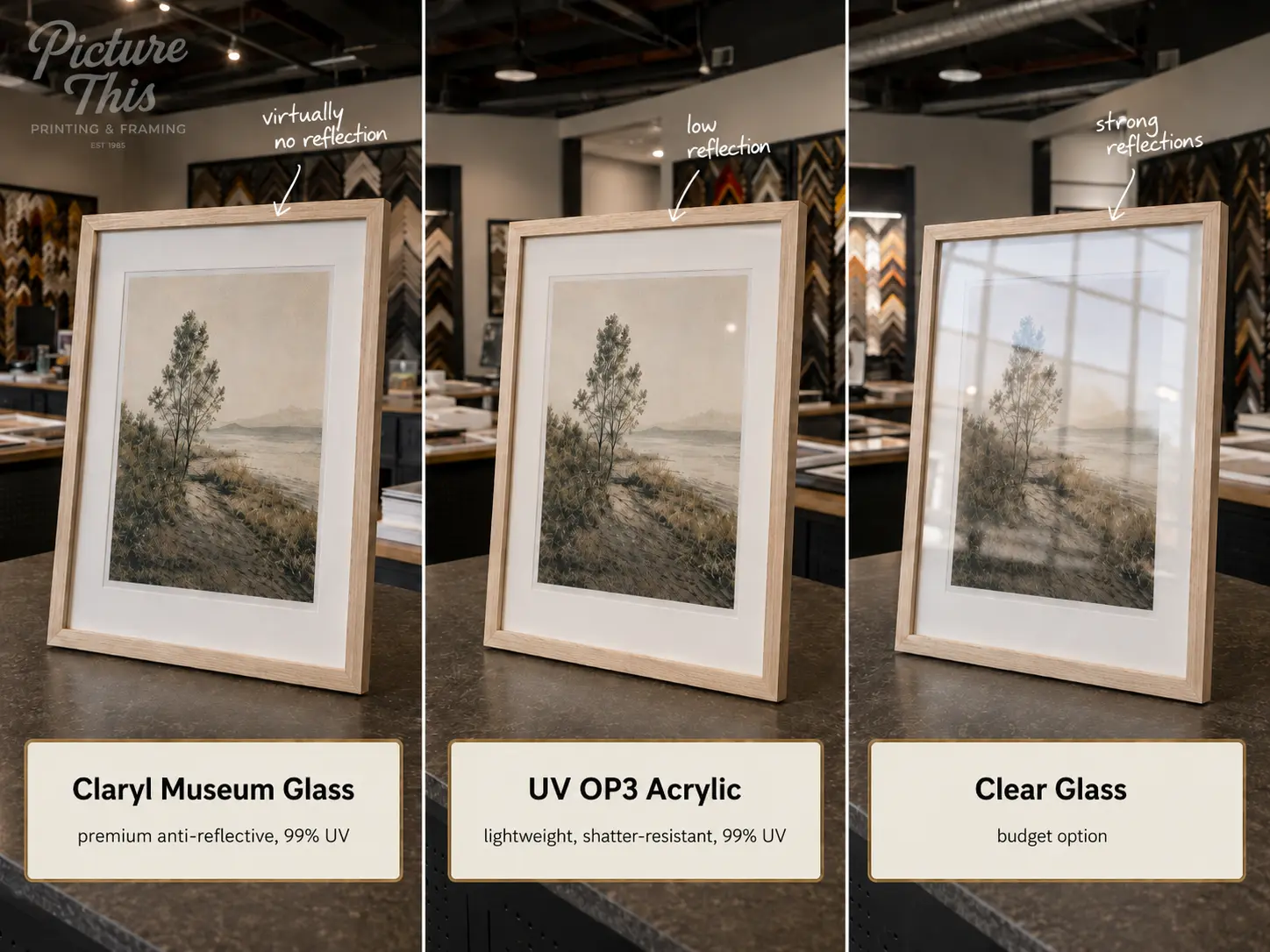
Fine art paper + UV OP3 Acrylic = the commercial workhorse. 99% UV protection, lightweight, shatter-resistant. Our recommendation for 70–80% of pieces in a typical program. The best combination of protection, weight, and value at volume.
Fine art paper + Claryl Museum Glass = the premium upgrade. Anti-reflective, 99% UV, maximum optical clarity. Use for lobby focal pieces, boardroom art, and high-visibility walls where eliminating reflection justifies the glazing premium. Achieves 90% of acrylic face-mount’s visual impact at 40% of the cost — with full repairability.
Fine art paper + standard clear glass = budget-appropriate for back-of-house, staff areas, or programs where volume matters more than UV protection.
No other substrate offers this kind of presentation flexibility. Metal looks like metal. Acrylic looks like acrylic. Paper + framing can look like anything.
For a complete glazing breakdown, see our UV-Protective Glazing Comparison.
Production Considerations at Volume
Swipe to see all columns
| Factor | Fine Art Paper | Canvas | Metal | Acrylic Face-Mount | Wood |
|---|---|---|---|---|---|
| Daily output (our facility) | 80–150+ pieces | 40–60 pieces | 30–50 pieces | 15–25 pieces | 30–50 pieces |
| Bottleneck | Framing/assembly | Stretching/mounting | Heat press scheduling | Curing time | Surface prep |
| Color consistency run-to-run | Excellent | Excellent | Good (varies by panel) | Excellent | Moderate |
| Reprint turnaround | Same day | 1–2 days | 2–3 days | 3–5 days | 2–3 days |
| File requirements | 300 DPI at print size | 300 DPI at print size | 300 DPI, CMYK preferred | 300 DPI, high-res critical | 300 DPI, high-contrast best |
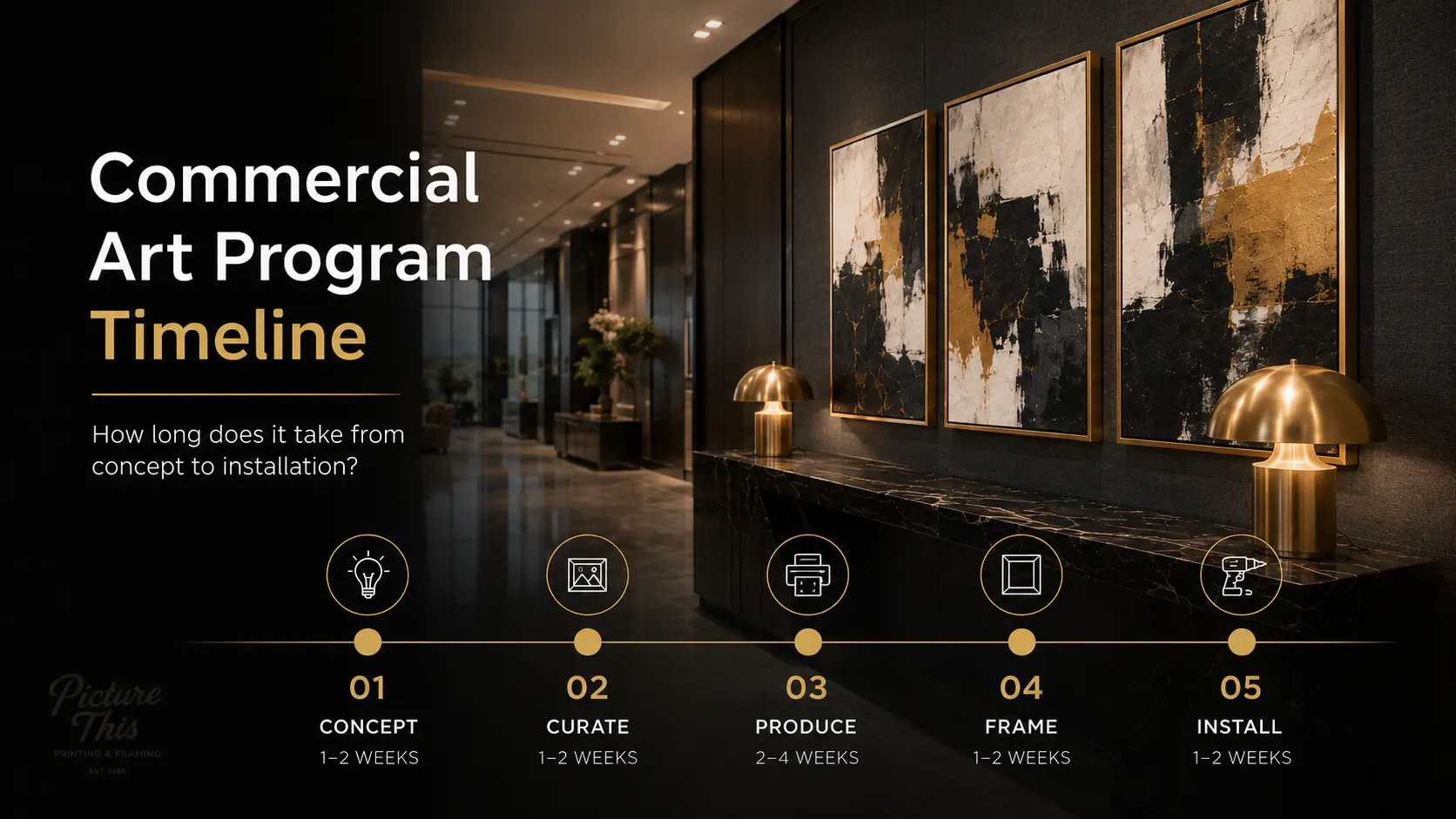
For programs with tight timelines, paper is the fastest path to delivery. A 300-piece hotel program on fine art paper can move through production in 2–3 weeks. The same program on metal or acrylic face-mount takes 4–6 weeks.
When planning multi-property rollouts with phased delivery, production speed matters. See our Phased Art Program Planning Guide for timeline frameworks.
How to Specify Substrate in Your RFP
When writing your art program specification, include:
Primary substrate for volume pieces (guest rooms, corridors, standard offices)
Feature substrate for statement and focal pieces (lobbies, reception, dining)
Environment-specific substrates for special conditions (pool, spa, maritime, healthcare)
Finish preference within each substrate (matte paper vs. luster, brushed metal vs. glossy, etc.)
Presentation method (framed, float-frame, frameless float, gallery-wrap)
Specifying a *look and intent* rather than a specific product gives your vendor flexibility to recommend the best option at your budget. "Warm, textured, gallery-quality presentation for guest rooms" is more useful than "canvas" — because that intent might be better served by velvet paper in a float-frame at half the cost.
For a complete guide to writing specifications that get you accurate quotes, see our Art Program RFP Guide.
Our Substrate Capabilities
At our Fullerton facility, we produce fine art paper printing, canvas printing, and custom framing entirely in-house — from file to finished piece under one roof. This gives us full quality control, faster turnaround, and the ability to match color precisely across an entire program.
For metal, acrylic face-mount, and wood plaque-mount substrates, we work with trusted specialty production partners and manage the process end-to-end. You get single-point accountability regardless of substrate.
Fine art paper (IN-HOUSE): Large-format archival pigment printing up to 64" wide on 9+ paper types
Canvas (IN-HOUSE): Archival pigment on poly-cotton and pure cotton canvas, stretched, mounted, or framed
Custom framing (IN-HOUSE): Complete frame assembly including matting, mounting, glazing, and finishing
Metal: Dye-sublimation onto aluminum panels up to 48x96"
Acrylic face-mount: Optically bonded to polished acrylic with aluminum composite backing
Wood plaque-mount: Printed or transferred onto sealed lightweight wood panels
The in-house advantage for paper and canvas means faster turnaround, easier revisions, tighter color matching, and lower cost at volume. It’s another reason paper + framing is the foundation of every program we recommend.
Frequently Asked Questions
Which print substrate lasts longest in a commercial environment?
Fine art paper behind UV-protective glazing has the longest proven archival life — 100+ years with archival pigment inks. Metal and acrylic face-mount prints are rated for 50–75+ years. Canvas with UV varnish lasts 25–50 years. Wood substrates last 20–40+ years in controlled indoor environments.
What is the best print substrate for hotel guest rooms?
Fine art paper (framed with UV OP3 acrylic glazing) is the standard for most hotel programs. It offers the widest range of finishes, the best archival performance, and pairs with any frame profile. Canvas is a strong alternative when a warmer, texture-forward aesthetic fits the brand.
Are metal prints durable enough for high-traffic commercial spaces?
Yes. Metal prints are scratch-resistant, moisture-proof, and require no glazing or framing. They are excellent for modern corporate lobbies, restaurant feature walls, and pool-adjacent areas. However, they dent on hard impact and cannot be repaired — only replaced.
What is a plaque-mounted wood print?
A plaque-mounted wood print is an image printed or transferred onto a lightweight wood substrate with a sealed surface. The wood grain can show through for a natural texture, or the surface can be opaque for full-color reproduction. They are frameless, lightweight, and have a distinctive organic aesthetic.
Can acrylic face-mount prints be used near windows?
Yes, but with caution. Acrylic provides some UV filtering, and most face-mount processes use UV-stable adhesives. However, direct sustained sunlight will still degrade the print over time. For window-adjacent placements, a framed print behind UV OP3 acrylic glazing provides better long-term protection.
Which substrate is cheapest at volume for a large commercial program?
Fine art paper is typically the lowest cost per piece at volume because the media itself is inexpensive and production is fast. Canvas is slightly higher due to stretching or mounting labor. Metal, acrylic, and wood substrates cost more per unit but eliminate framing costs, which can offset the difference depending on the program.
Do metal prints work on cruise ships?
Yes. Metal prints are lightweight, moisture-immune, and shatter-proof — all advantages in maritime environments. They comply with weight restrictions and perform well in high-humidity zones. The main limitation is repairability: a dented metal print must be replaced entirely.
What substrate should I specify for healthcare environments?
Framed fine art paper behind sealed acrylic glazing is the standard for healthcare. The sealed frame package meets infection-control requirements (wipeable, dust-tight). Frameless options like metal or acrylic face-mount can work in administrative areas but may not meet infection prevention committee requirements in patient-care zones where sealed, cleanable assemblies are mandatory.
Ready to Build Your Program on the Right Foundation?
Whether you're planning a 100-room hotel, a corporate headquarters, or a multi-site restaurant rollout, our recommendation is consistent: start with fine art paper + custom framing as your program foundation. It’s what we do best, it’s what delivers the best long-term value for our clients, and it’s what we produce entirely in-house for maximum quality control and speed.
We’ll help you select the right paper finish, frame profile, and glazing for each zone — and identify the 5–10% of pieces where an alternative substrate genuinely makes sense.
Call (714) 447-8749 or request a consultation to discuss your program. We'll send physical samples of any paper finish and frame combination so you can evaluate under your actual conditions — not ours. For programs of 50+ pieces, substrate consulting and sample development are included in our project management at no additional cost.
Located at 631 S. State College Blvd, Fullerton, CA 92831 — just north of Disneyland in Orange County. We welcome in-person visits to see every paper, finish, frame, and glazing option side-by-side in our production facility.
Industries We Serve
Questions About Your Project?
Our team in Fullerton is here to help with commercial art installations, custom framing, and museum-quality printing. Call us or request a quote to discuss your specific needs.